Africa · Subterranean
Matmata Underground Dwellings
Tunisia
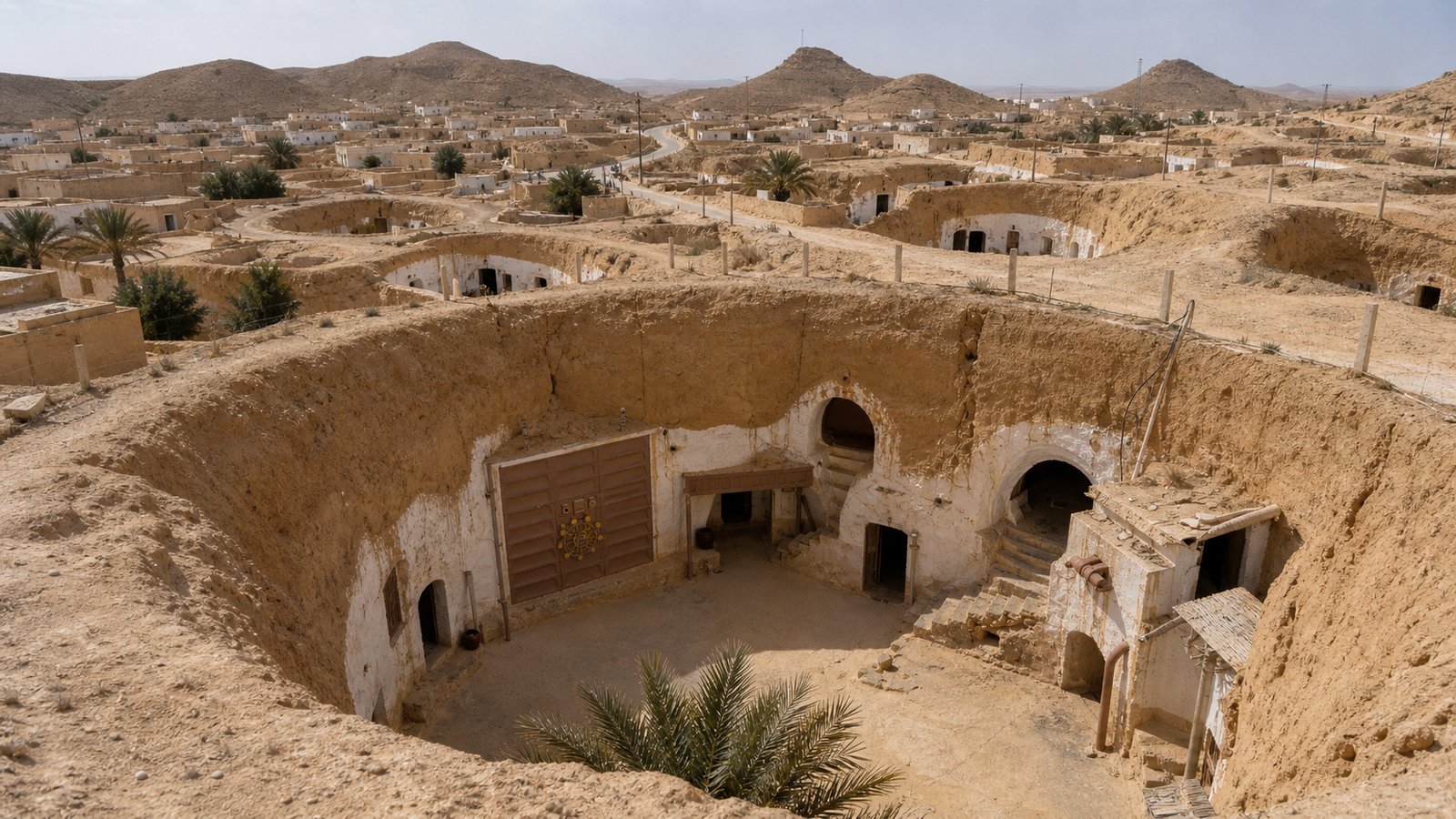
Old Matmata’s sunken courtyard homes offer sleeping, cooking and storage space with little dependence on powered cooling. That comfortable shelter is dispersed across a settlement, with many separate approaches and no established independent water or food supply for the group.
Overall
5 out of 10Defensibility
2 out of 10Isolation
6 out of 10Sustainability
7 out of 10Ranking context
How this base ranks
Global
#39 of 88 · Top 44%
Region · Africa
#1 of 11 · Top 9%
Base Type · Subterranean
#5 of 10 · Top 50%
Field assessment
At a glance
Bottom Line
A promising place for daily habitation, provided water replenishment is verified. The useful unit is an occupied group of homes; the wider settlement cannot be treated as one secured underground fortress.
Biggest Trade-off
Dispersed dwellings give room to live without crowding, but every extra occupied courtyard creates another entrance to watch and another surface journey to coordinate.
Most Likely Failure
Water or food collection repeatedly draws people away from the occupied homes, leaving scattered entrances poorly watched and turning routine provision into the principal exposure.
Score rationale
Why it scores this way
Defensibility · 2/10
Tunnel entrances and recessed rooms give individual homes useful shelter and limited access points. Across Old Matmata, however, many separate courtyards remain a defensive burden with no common perimeter or gate.
Advantages
- An occupied dwelling can focus attention on its own entrance passage.
Limitations
- People moving between homes leave that local protection and return to the surface network.
Isolation · 6/10
The dispersed upland settlement is separated from dense urban concentrations, but remains inhabited and road-connected. Underground accommodation changes local visibility; it does not create further geographic distance from incoming pressure.
Advantages
- Low-density settlement reduces immediate concentration compared with an urban compound.
Limitations
- Roads and connecting paths still allow movement into the occupied area.
Sustainability · 7/10
Purpose-built domestic rooms and passive temperature regulation make the dwellings useful homes with few cooling dependencies. Reliable daily habitation still requires verified water, sanitation and cooking arrangements rather than assuming traditional design supplies every need.
Advantages
- Sleeping, cooking and storage functions already fit the building form.
Limitations
- A comfortable room cannot compensate for an unverified drinking-water replacement routine.
Survival horizons
How survival changes over time
Choose homes that work together
First 7 Days
Inspect rooms, entrance passages and courtyards, then establish water handling and waste routines. Keep the occupied cluster small enough that daily household work does not require constant movement between distant homes.
Positive factors
- Existing domestic spaces support an organised start without new shelter construction.
Risks
- Treating the whole settlement as secured conceals separate approaches and surface crossings.
Supply trips set the rhythm
First 100 Days
As household provisions are consumed, measure replenishment effort and the condition of occupied rooms. Coordinate necessary surface journeys with watches so that finding supplies does not leave homes repeatedly unattended.
Positive factors
- Passive thermal performance reduces dependence on a fuelled cooling system.
Risks
- Unquantified water and sanitation capacity can constrain residence despite ample sleeping space.
Domestic shelter needs renewal
Long Term
Long residence requires repeatable safe water and food alongside maintainable homes. Traditional storage can protect supplies; it cannot replace a verified source or demonstrate a complete diet within the assessed settlement.
Positive factors
- Core excavated shelter retains value as complex machinery becomes harder to maintain.
Risks
- Dispersal continues to divide labour between household upkeep, movement and separate watches.
Visual survey
Gallery
Location context
The Lay of the Land
Tactical assessment
Practical Reality
Best Use
Choose a manageable cluster of inspected homes, keeping sleeping, cooking and stores close together. Plan surface routes between them explicitly instead of assuming underground rooms form a connected secure network.
Strengths
- Bedrooms, kitchens and cellars provide purpose-built spaces for ordinary life.
- Earth around the rooms moderates temperature without relying on powered cooling.
- Separate homes allow sleeping, storage and other activities to be distributed without crowding one room.
Key Risk
Protected household water storage helps preserve supplies already present; it does not establish the source, quantity or renewal needed to keep a resident community supplied.
Weaknesses
- Each dwelling has its own approach; securing one entrance leaves other homes outside that protection.
- Sunken rooms and courtyards do not provide continuous observation of the surrounding surface.
- Storage spaces and traditional water containers do not establish current stock levels or renewal.
Reality Check & Constraints
These are homes with practical domestic spaces, not empty military tunnels. Their value lies in passive shelter and household organisation; existing contents, sanitation performance and dependable replenishment remain unverified.
Assumptions / constraints
- The Base remains the traditional Old Matmata settlement, not a substituted single private compound.
- External farmland, utilities and future resupply are not counted as guaranteed resources.
- A small community can organise household tasks and ordinary upkeep; present sanitation, water reserves and equipment condition must be checked.
Decision context
Rivals / Alternatives
Similar rival
Seychelles
Seychelles · Isolated Landmass
Seychelles keeps the same Africa risk context, with only 0.3 points between the overall scores and closely matched sustainability pressure.
Overall 4.7/10
Strongest alternative
Amundsen-Scott South Pole Station
Antarctica · Institutional Compound
Amundsen-Scott South Pole Station scores 7.7 overall versus 5.0, adding a stronger isolation profile while staying relevant as a comparable survival plan.
Overall 7.7/10
Wildcard rival
San Felipe Fortress
Colombia · Fortified Structure
San Felipe Fortress changes the strategy: it is built around the fortified structure strategy with a defensibility edge, while Matmata Underground Dwellings holds more of the isolation advantage.
Overall 3.7/10