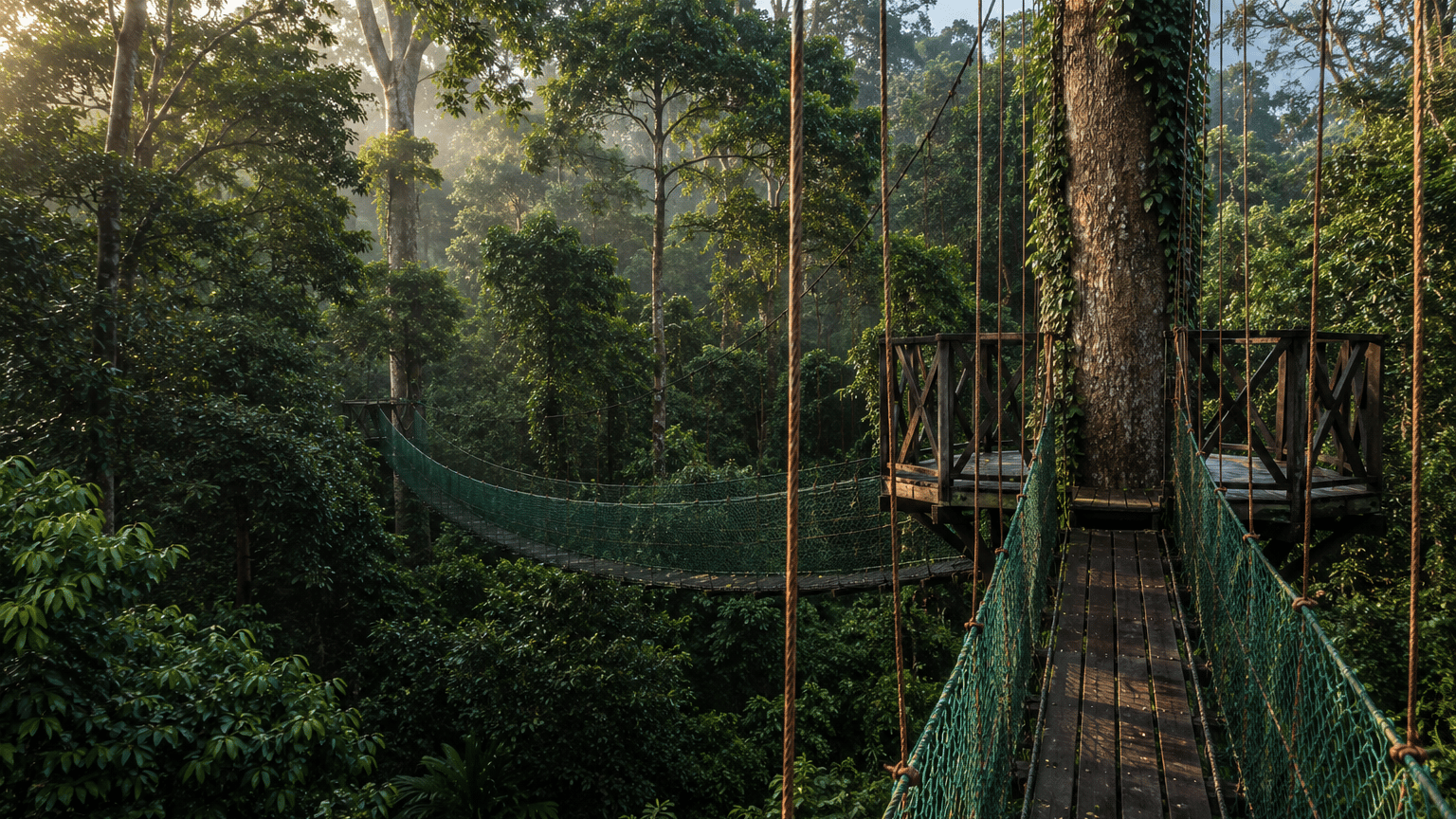
Southeast Asia · Institutional Compound
Danum Valley Field Centre
Malaysia
Danum Valley Field Centre offers established rainforest accommodation and a local catchment water supply, far from major settlements. Its long access road limits ordinary arrivals but also carries the food, fuel and maintenance support that keep the centre comfortable.
Overall
6 out of 10Defensibility
2 out of 10Isolation
8 out of 10Sustainability
8 out of 10Ranking context
How this base ranks
Global
#12 of 88 · Top 14%
Region · Southeast Asia
#1 of 7 · Top 14%
Base Type · Institutional Compound
#2 of 6 · Top 33%
Field assessment
At a glance
Bottom Line
A capable remote place to live, provided the group can sustain water handling, sanitation and essential supplies. Beds and a dining hall solve accommodation more readily than they solve replenishment.
Biggest Trade-off
The forest road provides valuable separation and channels vehicle access, yet puts replacement supplies at the end of a long journey. Restricted entry is useful warning, not a hardened perimeter around the occupied buildings.
Most Likely Failure
Fuel or an unrepairable service fault disrupts food storage and daily water or sanitation routines. The buildings remain, but the group cannot maintain the support that made the remote compound habitable.
Score rationale
Why it scores this way
Defensibility · 2/10
Ordinary buildings can be secured and the private road concentrates normal arrivals. Once pressure reaches the compound, no evidenced hardened enclosure or protected fallback system turns it into a fortified position.
Advantages
- Existing accommodation gives a choice of indoor positions for a compact occupied area.
Limitations
- Dense forest and connected paths prevent treating the vehicle checkpoint as control of every approach.
Isolation · 8/10
A long inland journey, largely on a private unsealed road, separates the centre from Lahad Datu. This sharply reduces easy access from population centres while leaving an established route into the forest.
Advantages
- The lengthy managed approach makes casual regional movement less direct than at a town-edge compound.
Limitations
- Research and visitor access demonstrate a connection that can carry threats as well as supplies; forest cover is not a sealed barrier.
Sustainability · 8/10
Accommodation, bathrooms, food-preparation space and drinking-water provision establish a functioning residential site. Continued habitation depends on reproducing those daily services with a much smaller workforce and less reliable logistics.
Advantages
- A documented local catchment supplies raw water, reducing dependence on imported water alone.
Limitations
- Raw-water availability does not remove treatment and distribution work, and scheduled generator operation still requires fuel and maintenance.
Survival horizons
How survival changes over time
Check the service chain
First 7 Days
Confirm usable sleeping space, water handling, sanitation and actual food and fuel reserves. Identify manageable routes between these facilities and the approaches that need observation before occupying more buildings.
Positive factors
- Established rooms, kitchens and communal facilities provide a practical basis for daily organisation.
Risks
- A remote arrival does not establish working equipment or an uncontaminated compound; local conditions still need checks.
Reduce dependence on routine deliveries
First 100 Days
Consumption and ordinary maintenance become the central workload. Track generator fuel and food use, maintain water handling and sanitation, and organise essentials around the documented overnight interruption to electricity.
Positive factors
- The centre already operates with a scheduled power gap rather than requiring electricity continuously for every activity.
Risks
- A planned overnight shutdown does not prove refrigeration, treatment or other services remain usable through permanent fuel loss.
Match renewal to the workforce
Long Term
Continuing water intake provides a starting resource that can be renewed, but the group still needs safe handling, food replenishment and serviceable equipment. No autonomous replacement for the external food and fuel chain is established.
Positive factors
- The catchment source distinguishes this position from a refuge dependent entirely on stored or delivered water.
Risks
- Forest abundance does not prove accessible food yields; exhausting supplies or repair capacity can end occupation while accommodation remains intact.
Visual survey
Gallery
Location context
The Lay of the Land
Tactical assessment
Practical Reality
Best Use
Concentrate sleeping, food preparation and supply checks within a manageable occupied part of the compound. Monitor the final road approach while protecting everyday access to the centre’s water and service facilities.
Strengths
- Existing bedrooms, hostel space and shared facilities offer substantial capacity for a small community.
- The long private-road approach limits easy movement from regional settlements.
- A documented catchment intake gives the centre a genuine local raw-water source.
Key Risk
A small group can occupy the accommodation without inheriting the research station’s operating workforce. Fuel handling, water care, cleaning, repairs and watches still compete for the same limited labour.
Weaknesses
- The forest setting conceals foot approaches that a road checkpoint cannot resolve.
- Electricity depends on generators and a continuing fuel and maintenance chain.
- Meal provision depends on a working supply operation; on-site food production sufficient for the group is not established.
Reality Check & Constraints
The Field Centre is not the separate Borneo Rainforest Lodge, and the surrounding conservation forest is not a stocked larder. Available rooms and advertised meal service do not establish actual reserves or a self-sufficient food system.
Assumptions / constraints
- The approved Field Centre/Studies Centre compound and integrated access and utility facilities remain the Base. The wider reserve and separate lodges are not added as controlled land, food stores or backup accommodation.
- Twenty capable adults can organise watches and ordinary maintenance. No resident ranger team, research crew, specialist mechanic or reliable transport fleet is assumed to remain available.
- Water quality, stocks and equipment condition require checks. No guaranteed forest harvest, resupply, evacuation, new power system or survival duration is credited.
Decision context
Rivals / Alternatives
Similar rival
Tambopata Research Center
Peru · Institutional Compound
Tambopata Research Center keeps the same institutional compound strategy, with only 0.3 points between the overall scores and closely matched sustainability pressure.
Overall 5.7/10
Strongest alternative
Amundsen-Scott South Pole Station
Antarctica · Institutional Compound
Amundsen-Scott South Pole Station scores 7.7 overall versus 6.0, adding a stronger defensibility profile while staying relevant as another institutional compound.
Overall 7.7/10
Wildcard rival
San Felipe Fortress
Colombia · Fortified Structure
San Felipe Fortress changes the strategy: it is built around the fortified structure strategy with a defensibility edge, while Danum Valley Field Centre holds more of the isolation advantage.
Overall 3.7/10