Middle East · Institutional Compound
Al Udeid Air Base
Qatar
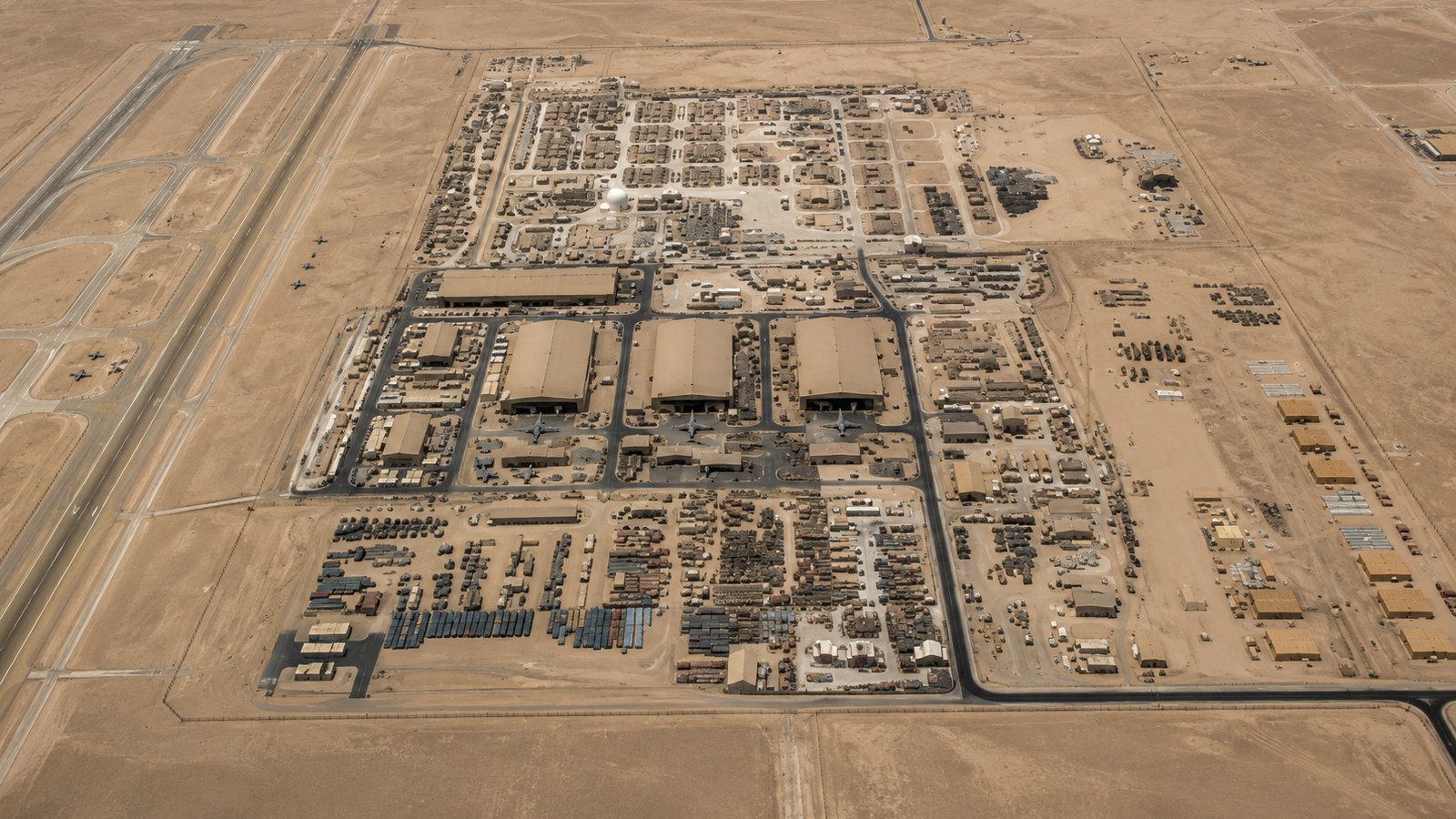
Al Udeid offers hardened accommodation and extensive support facilities outside Doha. For twenty survivors, the challenge is keeping a small occupied core habitable without inheriting the installation’s workforce or supply chain.
Overall
5.7 out of 10Defensibility
5 out of 10Isolation
4 out of 10Sustainability
8 out of 10Ranking context
How this base ranks
Global
#18 of 88 · Top 20%
Region · Middle East
#2 of 5 · Top 40%
Base Type · Institutional Compound
#4 of 6 · Top 67%
Field assessment
At a glance
Bottom Line
Choose it for usable shelter and support infrastructure, provided the group can verify water, cooling and power before committing to stay.
Biggest Trade-off
A base built for thousands offers space to spare, but its perimeter and utilities demand more labour than twenty people can supply.
Most Likely Failure
A utility fault makes occupied rooms difficult to inhabit while food, parts and outside technical support are already becoming harder to replace.
Score rationale
Why it scores this way
Defensibility · 5/10
Hardened rooms and controlled entrances offer defensible positions. Their value depends on a manageable occupied core: the full air-base boundary is too extensive for twenty people to hold reliably.
Advantages
- Existing hardened accommodation provides physical protection without relying on current military personnel.
Limitations
- Controlling selected rooms does not secure every road, service area or approach across the installation.
Isolation · 4/10
Desert separation from Doha reduces immediate urban contact, but connected roads still link the installation to the wider populated region. Open surroundings are a buffer, not remote refuge.
Advantages
- Distance across open ground separates the occupied buildings from the metropolitan core.
Limitations
- Normal road connections remain potential routes for regional pressure as well as supplies.
Sustainability · 8/10
Accommodation, dining and utility infrastructure can support daily living, but only while the systems serving the chosen rooms work. Spare floor space cannot replace potable water or manageable cooling.
Advantages
- Existing domestic and support facilities reduce the amount of shelter the group must improvise.
Limitations
- Desert habitability depends on engineered services; their existence does not establish independent renewal or ordinary-survivor maintainability.
Survival horizons
How survival changes over time
Find a workable core
First 7 Days
Check access, safe rooms, water and essential utilities before spreading out. Inventory what is actually usable and match watchkeeping to the occupied area.
Positive factors
- Hardened accommodation provides a practical place to concentrate the group if inspected and serviceable.
Risks
- An apparently equipped room may depend on a larger utility network the group cannot operate.
Reduce the operating burden
First 100 Days
Track consumption and routine faults, identify the systems that serve occupied rooms, and limit non-essential demand. Do not attempt to reproduce normal base operations.
Positive factors
- A small occupied footprint avoids spending every available person on unused buildings and facilities.
Risks
- Fuel, filters, parts and technical knowledge may become limiting before accommodation space does.
Prove resource renewal
Long Term
Remaining requires repeatable water, energy and food provision that twenty adults can maintain. The approved evidence establishes infrastructure, not a demonstrated autonomous settlement.
Positive factors
- Durable built space remains useful if a viable, maintainable resource pathway can be verified.
Risks
- A smaller footprint alone cannot replace external consumables or establish independent water and food production.
Visual survey
Gallery
Location context
The Lay of the Land
Tactical assessment
Practical Reality
Best Use
Concentrate sleeping, watchkeeping and essential utility use around the smallest serviceable accommodation area; leave the wider installation outside the routine occupied footprint.
Strengths
- Hardened dormitories offer existing protected accommodation, allowing the group to select a useful core rather than improvise shelter across the airfield.
- Documented dining, water and sewer infrastructure provides a starting framework for daily life if the relevant systems remain serviceable.
- Large accommodation capacity leaves room to separate sleeping, storage and work without needing to expand the installation.
Key Risk
Cooling, water and sanitation can depend on systems whose scale and specialist maintenance exceed the needs and skills of a small group.
Weaknesses
- A wide airfield perimeter spreads observation and response duties across far more ground than the occupied rooms require.
- Modern utilities normally supported by specialist maintenance can become a bottleneck even when buildings remain intact.
- Food-storage and drinking-water facilities do not establish replenishable food or an independent primary water and energy source.
Reality Check & Constraints
This assessment retains the approved installation boundary and twenty capable adults. Documented infrastructure is not proof of present serviceability, accessible stocks or an inherited engineering team.
Assumptions / constraints
- No current troops, aircraft, weapons, contractors or guaranteed external deliveries transfer to the twenty-survivor group.
- Accessible water, food, spare parts and equipment condition must be checked; no reserve quantity or survival duration is assumed.
Decision context
Rivals / Alternatives
Similar rival
Guantanamo Bay
Cuba · Institutional Compound
Guantanamo Bay keeps the same institutional compound strategy, with only 0.3 points between the overall scores and closely matched sustainability pressure.
Overall 6/10
Strongest alternative
Amundsen-Scott South Pole Station
Antarctica · Institutional Compound
Amundsen-Scott South Pole Station scores 7.7 overall versus 5.7, adding a stronger isolation profile while staying relevant as another institutional compound.
Overall 7.7/10
Wildcard rival
Great Mosque of Djenné
Mali · Landmark Structure
Great Mosque of Djenné changes the strategy: it is built around the landmark structure strategy without a headline-pillar edge over Al Udeid Air Base, while Al Udeid Air Base holds more of the sustainability advantage.
Overall 1.3/10