Oceania · Remote Settlement
Coober Pedy Underground Settlement
Australia
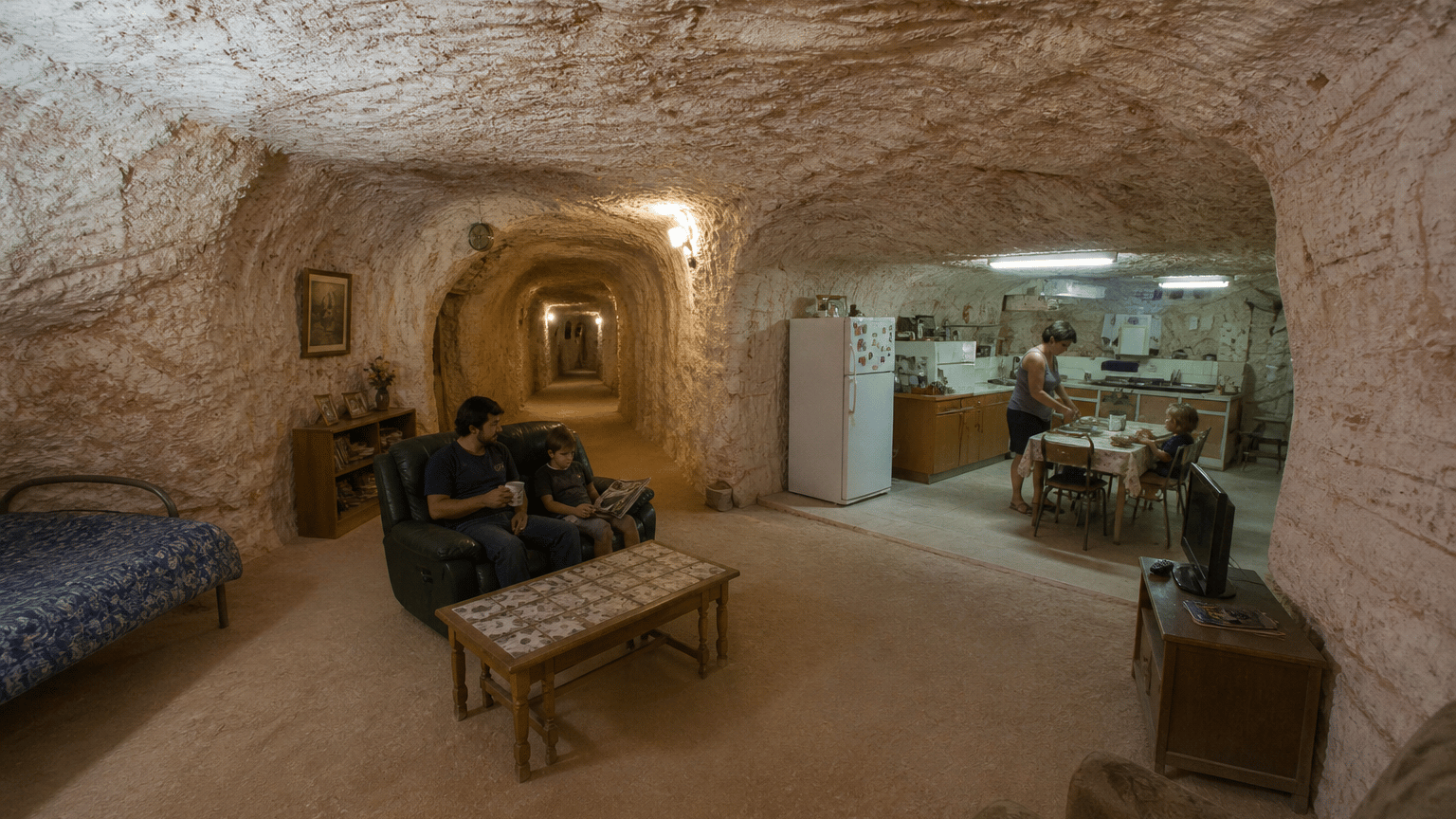
Coober Pedy combines heat-buffering underground homes with the services of an established outback town. Distance limits incoming pressure, but scattered dugouts do not form a fortress, and drinking water still depends on powered treatment.
Overall
5.7 out of 10Defensibility
2 out of 10Isolation
7 out of 10Sustainability
8 out of 10Ranking context
How this base ranks
Global
#21 of 88 · Top 24%
Region · Oceania
#1 of 4 · Top 25%
Base Type · Remote Settlement
#2 of 16 · Top 13%
Field assessment
At a glance
Bottom Line
A strong desert habitat if its water system remains usable. Occupying a comfortable dugout is much simpler than keeping the township infrastructure behind it running.
Biggest Trade-off
The settlement offers far more rooms and services than a small group needs, spread across far more ground than it can defend. Choosing shelter also means choosing which essential journeys remain manageable.
Most Likely Failure
An unrepairable pumping or treatment fault interrupts drinking-water production while the dugouts remain habitable. Distance then makes replacement parts and outside support difficult to obtain.
Score rationale
Why it scores this way
Defensibility · 2/10
Individual dugouts offer substantial shelter and entrances that can be secured, but the occupied town has no continuous defensive boundary. Protecting one home does not control the roads and service premises around it.
Advantages
- Underground living spaces give a small group protected positions without first constructing substantial shelter.
Limitations
- Every separate supply or utility destination adds ground to watch; twenty people cannot hold the distributed town as one enclosure.
Isolation · 7/10
Long outback distances separate the town from major population centres. The Stuart Highway still provides a direct movement corridor, so remoteness reduces regional pressure without sealing the settlement off.
Advantages
- Large distances impede ordinary movement from major cities into the area.
Limitations
- Existing residents and people arriving along the highway remain local threats that distance cannot exclude.
Sustainability · 8/10
Purpose-built underground homes buffer desert heat, supported by established water, electricity and community facilities. This is proven residential habitat, with continuing dependence on the systems that make desert living practical.
Advantages
- Passive insulation preserves part of the shelter advantage even when powered cooling is unavailable.
Limitations
- Bore water needs pumping and reverse osmosis; useful housing does not provide an equipment-free drinking-water supply.
Survival horizons
How survival changes over time
Find shelter and working water
First 7 Days
Check accessible dugouts, drinking-water delivery and nearby supplies before spreading people across the town. Identify the routes linking these needs and the entrances the group can actually watch.
Positive factors
- Existing accommodation and town premises offer a starting point for sleeping, storage and organisation.
Risks
- Unverified water service or inaccessible stores can undermine occupation immediately, however comfortable the chosen rooms.
Keep treatment dependable
First 100 Days
As supplies are consumed, track food and fuel use alongside the condition of pumping, treatment and power equipment. Share routine operating knowledge while keeping the workload within the small group’s capabilities.
Positive factors
- The documented hybrid electricity system has several generation sources, reducing reliance on diesel generation alone.
Risks
- Renewable generation does not replace membranes, pumps, controls or repair skills; a small fault can become a water-service problem.
Renew essentials, not just reserves
Long Term
Long occupation requires repeatable drinking-water production and replenishment of food and worn parts. Dugouts retain passive value, but neither careful rationing nor the presence of local energy establishes a complete autonomous desert settlement.
Positive factors
- Underground thermal shelter continues to reduce one everyday demand on powered infrastructure.
Risks
- No dependable replacement for long-distance food, diesel and specialist material supply is established for the group.
Visual survey
Gallery
Location context
The Lay of the Land
Tactical assessment
Practical Reality
Best Use
Keep the occupied footprint compact around checked accommodation and reliable access to drinking water. Account for journeys to supplies and utility facilities rather than treating the entire township as a secured compound.
Strengths
- Underground housing provides an established way to limit exposure to desert heat.
- Town accommodation and community facilities offer considerable space for separating living, storage and work.
- Bore-fed water treatment and diversified local power are real infrastructure rather than hypothetical future projects.
Key Risk
Local water production and renewable generation can look like independence. Both still rely on maintained equipment, while food, diesel and specialist parts normally arrive over long supply routes.
Weaknesses
- The road-connected spread of homes and services leaves many approaches outside any one secured position.
- Safe water depends on a technical production and distribution chain that must remain serviceable.
- Distance that limits incoming pressure also complicates food, fuel and parts replacement.
Reality Check & Constraints
The inherited Base includes the township and its integrated utilities, not a single stocked bunker. Shops and service stations establish supply infrastructure, not the quantities, condition or accessibility of what survivors find.
Assumptions / constraints
- The township, dugouts and directly integrated municipal systems remain the approved Base. Distant mines, the airport and surrounding opal fields are not added as defended territory.
- Twenty capable adults have ordinary maintenance skills; utility engineers, medical staff and the existing town workforce are not assumed to join them.
- Actual stocks, water quality and plant condition require checks. No new desalination plant, expanded farming, guaranteed deliveries or survival duration is credited.
Decision context
Rivals / Alternatives
Similar rival
Siwa Oasis
Egypt · Remote Settlement
Siwa Oasis keeps the same remote settlement strategy, with only 0.0 points between the overall scores and closely matched defensibility pressure.
Overall 5.7/10
Strongest alternative
Amundsen-Scott South Pole Station
Antarctica · Institutional Compound
Amundsen-Scott South Pole Station scores 7.7 overall versus 5.7, adding a stronger isolation profile while staying relevant as a comparable survival plan.
Overall 7.7/10
Wildcard rival
San Felipe Fortress
Colombia · Fortified Structure
San Felipe Fortress changes the strategy: it is built around the fortified structure strategy with a defensibility edge, while Coober Pedy Underground Settlement holds more of the isolation advantage.
Overall 3.7/10