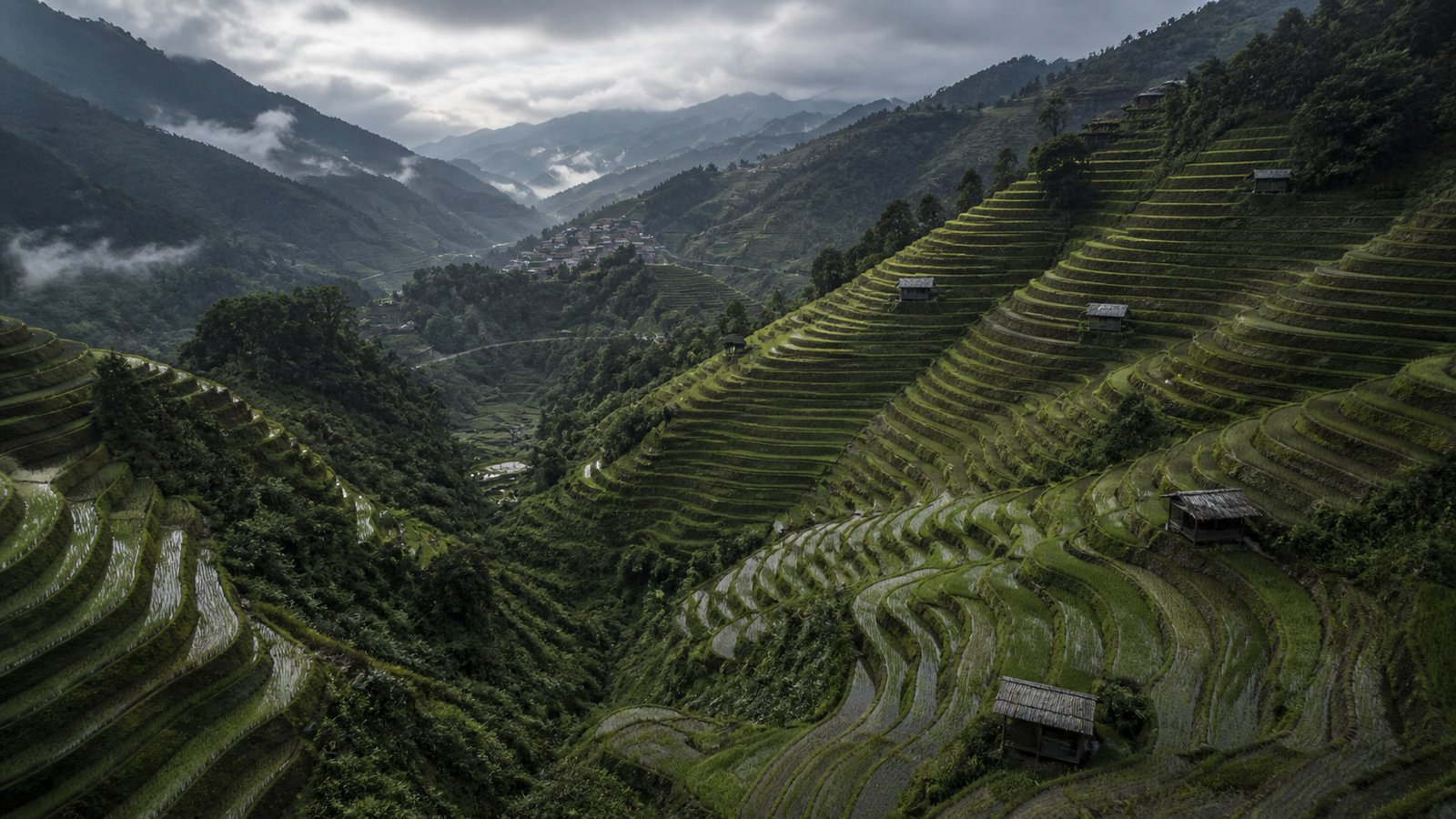
Southeast Asia · Elevated Stronghold
Batad Rice Terraces
Philippines
Batad combines a living mountain village with irrigated rice terraces and difficult approaches. Its refuge value rests on sustaining a skilled farming system, while safe drinking water and a manageable defensive position still need proving.
Overall
5 out of 10Defensibility
2 out of 10Isolation
6 out of 10Sustainability
7 out of 10Ranking context
How this base ranks
Global
#31 of 88 · Top 35%
Region · Southeast Asia
#2 of 7 · Top 29%
Base Type · Elevated Stronghold
#1 of 13 · Top 8%
Field assessment
At a glance
Bottom Line
A credible agricultural refuge if the group can keep water, cultivation and repairs working together; the terraces offer a food pathway, not an enclosed position or an immediate harvest.
Biggest Trade-off
The slopes that slow arrivals also make every load and repair harder to move between shelter, fields and water channels.
Most Likely Failure
Storm damage interrupts irrigation and paths, diverting people from cultivation and watches. If repairs exceed the group's skills or labour, occupied houses remain while the food system deteriorates.
Score rationale
Why it scores this way
Defensibility · 2/10
Batad's terrace walls shape agricultural land rather than enclose the village. Steep slopes impede movement, but a small watch team cannot seal the full bowl or protect every path used for daily work.
Advantages
- Terraced gradients and restricted practical approaches give observers useful warning before movement reaches the occupied area.
Limitations
- Anyone reaching the village is inside an open settlement; there is no continuous fortified boundary to contain pressure while others tend the fields.
Isolation · 6/10
The Cordillera setting and steep walking approaches separate Batad from easy regional movement. It remains an inhabited, visited village with established routes, so geographic distance cannot guarantee low pressure inside the settlement.
Advantages
- Reaching the village involves difficult terrain rather than an unobstructed journey through a continuous urban area.
Limitations
- The same access friction slows supply carrying and departure; remoteness gives no assurance of a clear route back to regional services.
Sustainability · 7/10
Existing houses, cultivated paddies and forest-fed communal irrigation make Batad a functioning habitat with a local food-production pathway. Continued use depends on agricultural knowledge and upkeep, not simply finding enough sleeping space.
Advantages
- The village and its integrated fields allow shelter and cultivation within one established operating landscape, without first creating farmland.
Limitations
- Irrigation water is not proven safe to drink, and rice cultivation alone establishes neither a complete diet nor a dependable independent energy supply.
Survival horizons
How survival changes over time
Secure water and safe circulation
First 7 Days
Inspect shelter, identify a safe drinking-water routine and check the paths between houses, fields and channels. Inventory accessible food and tools before treating a cultivated landscape as supplies ready for use.
Positive factors
- An existing village provides a starting place for sleeping and organising stores while the group assesses the agricultural system.
Risks
- Steep paths and damaged access can separate people doing essential checks; the first occupied house does not secure the journeys beyond it.
Balance cultivation with repairs
First 100 Days
Match food consumption to actual stores and crop condition, then divide labour between cultivation, channel clearing, wall repairs and watches. The first harvest cannot be assigned a date or yield from the landscape's reputation.
Positive factors
- Existing paddies and irrigation offer a production system to work with, rather than an entirely imported food supply.
Risks
- Repair demands can peak just when crops need attention; documented community restoration does not show that a much smaller group can repeat the same work.
Keep the next crop possible
Long Term
Endurance depends on repeated growing cycles, continued watershed and channel care, and enough shared knowledge to maintain them. Safe drinking water and a broader diet must remain dependable alongside rice production; outside rehabilitation teams cannot be assumed.
Positive factors
- Traditional water management and cultivation provide a renewal pathway that does not depend on replacing an entire industrial utility plant.
Risks
- Loss of farming knowledge or neglected terrace maintenance can gradually remove productive land even while houses remain habitable.
Visual survey
Gallery
Location context
The Lay of the Land
Tactical assessment
Practical Reality
Best Use
Keep occupation close to a verified drinking-water source and a workable part of the existing terrace system. Prioritise the paths and channels that serve it rather than trying to hold the entire amphitheatre.
Strengths
- The village is physically integrated with irrigated fields, keeping a genuine food-production pathway inside the evaluated landscape.
- Traditional houses and agricultural storage provide established living and working space for a small community.
- The steep amphitheatre channels practical movement and provides useful views of local approaches.
Key Risk
A small group can fit in the village yet lack the people and inherited farming knowledge needed to maintain the landscape supporting it. Available rooms do not measure that workload.
Weaknesses
- Cultivation and water management extend beyond any single occupied building, leaving essential daily work outside a protected enclosure.
- Typhoon damage has required organised repairs to paddies, trails and communal irrigation; restoration activity does not prove every section is now serviceable.
- Protected drinking-water treatment and storage are unverified, despite the documented agricultural water system.
Reality Check & Constraints
These are working terraces maintained through community knowledge and recurring labour. Neither their long history nor visible irrigation establishes today's edible stocks, safe drinking water or the condition of every damaged paddy and channel.
Assumptions / constraints
- Ordinary practical skills do not amount to an experienced Ifugao farming and irrigation team. Resident labour, equipment and supplies are not automatically available to the survivor group.
- The Base remains the Batad terrace cluster, village and directly integrated paths and irrigation. Other Ifugao clusters, Banaue town and external regional services are excluded.
- Crop readiness, stores, tools and damaged infrastructure require inspection. These horizons describe changing priorities, not guaranteed survival durations, harvests or future construction.
Decision context
Rivals / Alternatives
Similar rival
Banda Neira
Indonesia · Remote Settlement
Banda Neira keeps the same Southeast Asia risk context, with only 0.3 points between the overall scores and closely matched isolation pressure.
Overall 4.7/10
Strongest alternative
Amundsen-Scott South Pole Station
Antarctica · Institutional Compound
Amundsen-Scott South Pole Station scores 7.7 overall versus 5.0, adding a stronger isolation profile while staying relevant as a comparable survival plan.
Overall 7.7/10
Wildcard rival
San Felipe Fortress
Colombia · Fortified Structure
San Felipe Fortress changes the strategy: it is built around the fortified structure strategy with a defensibility edge, while Batad Rice Terraces holds more of the isolation advantage.
Overall 3.7/10