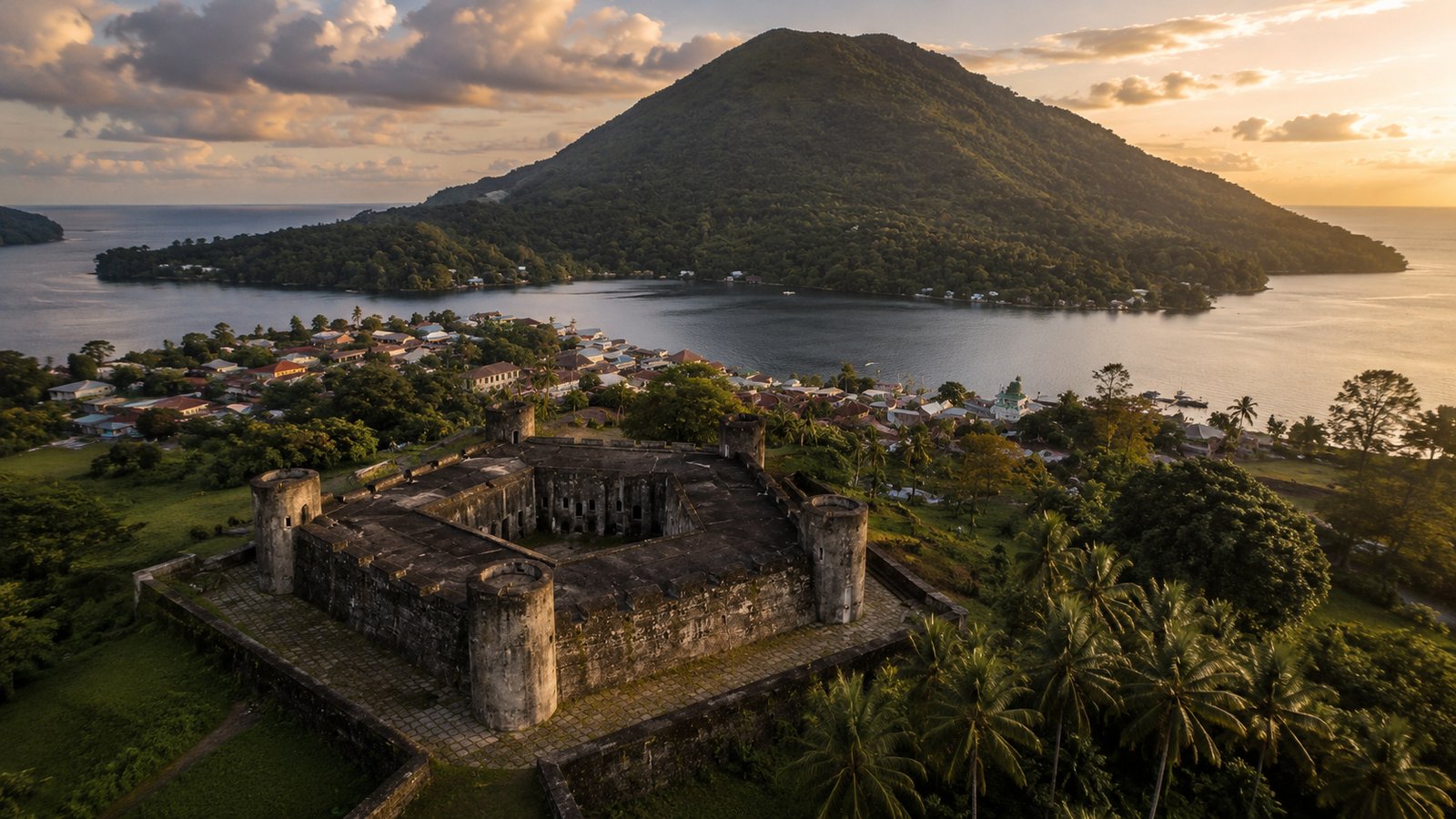
Southeast Asia · Remote Settlement
Banda Neira
Indonesia
Banda Neira offers sea separation, an established town and fishing access, but no island-wide defensive enclosure. Its refuge value depends on finding dependable drinking water and keeping daily needs within a small group's reach.
Overall
4.7 out of 10Defensibility
1 out of 10Isolation
7 out of 10Sustainability
6 out of 10Ranking context
How this base ranks
Global
#45 of 88 · Top 51%
Region · Southeast Asia
#3 of 7 · Top 43%
Base Type · Remote Settlement
#9 of 16 · Top 56%
Field assessment
At a glance
Bottom Line
Useful shelter and maritime distance give a small group a starting position; neither secures the streets nor proves that water and food can be replaced locally.
Biggest Trade-off
The sea limits pressure from distant populations while making replacement fuel, parts and supplies harder to reach.
Most Likely Failure
An interruption to the water supply or an unrepairable generator fault forces longer supply trips, spreading watches and maintenance effort across an island the group cannot fully secure.
Score rationale
Why it scores this way
Defensibility · 1/10
Banda Neira is the whole inhabited island, not Fort Belgica. Its port, public streets and accessible coastline leave too many routes for a small group to hold as one defended position.
Advantages
- Existing town buildings offer a choice of places to concentrate occupation, reducing the area that needs immediate attention.
Limitations
- Securing an occupied building does not secure the streets between shelter, water points and the waterfront. Historic forts do not enclose that wider daily circuit.
Isolation · 7/10
A remote sea crossing separates Banda Neira from major population centres. Its own resident population, nearby inhabited islands and established transport links still create local contact pressure.
Advantages
- There is no mainland road approach; reaching the island from outside the archipelago requires maritime or air transport.
Limitations
- Distance from Ambon does not remove an outbreak already inside the town, and nearby boat arrivals remain a different problem from distant mainland movement.
Sustainability · 6/10
Housing, local services and fishing access provide a practical habitat without first building a settlement. Continued occupation depends on drinking-water continuity and on which services remain usable without the island's normal technical support.
Advantages
- A town built for thousands offers ample choice of sleeping, storage and work space for a small community.
Limitations
- District-level wells, springs and rainwater records do not establish a reliable source at every island property; generator-dependent services add a separate maintenance burden.
Survival horizons
How survival changes over time
Find a workable foothold
First 7 Days
Select shelter around a verified drinking-water source, inspect accessible supplies and establish watches on the routes the group actually uses. Taking possession of the whole town is beyond the initial task.
Positive factors
- Existing housing and streets allow an occupied area to be organised without constructing a new settlement.
Risks
- Local population pressure can already be inside the water barrier; controlling incoming boats alone does not make occupation safe.
Prove the daily supply routine
First 100 Days
Track actual water yield and food consumption, test what fishing contributes, and prioritise repairs that keep those routines working. Judge reserves from inventories and repeated results, not the number of buildings available.
Positive factors
- Documented local fishing offers a food pathway to assess alongside stored provisions, rather than relying entirely on the next delivery.
Risks
- Generator faults and difficult replacement logistics can erode services even when the occupied rooms remain sound.
Replace what occupation consumes
Long Term
Endurance requires repeatable water and food provision and a routine the group can maintain as fuel and parts become harder to replace. Neither continued ferry service nor food from neighbouring islands is an assured solution.
Positive factors
- Ordinary buildings retain shelter value without keeping every town service running; a smaller occupied area limits the upkeep the group takes on.
Risks
- Evidence of local fishing does not establish a complete, dependable diet; regional water records likewise leave Neira's year-round independent supply unproven.
Visual survey
Gallery
Location context
The Lay of the Land
Tactical assessment
Practical Reality
Best Use
Choose a compact occupied area with verified drinking water and manageable routes to essential stores and fishing access. Use the town selectively rather than trying to hold its entire shoreline.
Strengths
- Open-water separation removes direct mainland ground access and gives distance from large outside population sources.
- An established town provides a choice of existing buildings rather than a requirement to create shelter from scratch.
- An active fishing community establishes local experience and access, giving the group a resource pathway to investigate.
Key Risk
Shelter may be plentiful while safe daily access is scarce: repeated journeys through the town can consume the people needed for watches, water collection and repairs.
Weaknesses
- The coastline and public street network lack a continuous defensive enclosure suited to a small watch team.
- Water evidence spans the wider Banda district; availability, treatment and outage continuity at a particular Neira shelter remain unverified.
- Local generation has a documented maintenance vulnerability, with replacement fuel and parts tied to remote logistics.
Reality Check & Constraints
Regional records describe several freshwater sources, not a proven independent supply at the chosen shelter. An operating island town also does not establish usable stocks, working equipment or a replacement crew after disruption.
Assumptions / constraints
- The group has ordinary practical skills, not an assumed utility crew, expert fishing team or entitlement to supplies held by the island's residents.
- The whole Neira island and its directly integrated services remain the evaluated Base. Fort Belgica is not substituted for it; neighbouring islands and guaranteed Ambon deliveries are excluded.
- Stocks, equipment condition and safe access must be checked on arrival. The time horizons describe changing decisions, not guaranteed survival durations or future construction.
Decision context
Rivals / Alternatives
Similar rival
Kibber Village
India · Remote Settlement
Kibber Village keeps the same remote settlement strategy, with only 0.7 points between the overall scores and closely matched defensibility pressure.
Overall 5.3/10
Strongest alternative
Isle of Eigg Village
United Kingdom · Remote Settlement
Isle of Eigg Village scores 6.3 overall versus 4.7, adding a stronger defensibility profile while staying relevant as another remote settlement.
Overall 6.3/10
Wildcard rival
San Felipe Fortress
Colombia · Fortified Structure
San Felipe Fortress changes the strategy: it is built around the fortified structure strategy with a defensibility edge, while Banda Neira holds more of the isolation advantage.
Overall 3.7/10