South America · Remote Settlement
Huilloc Village
Peru
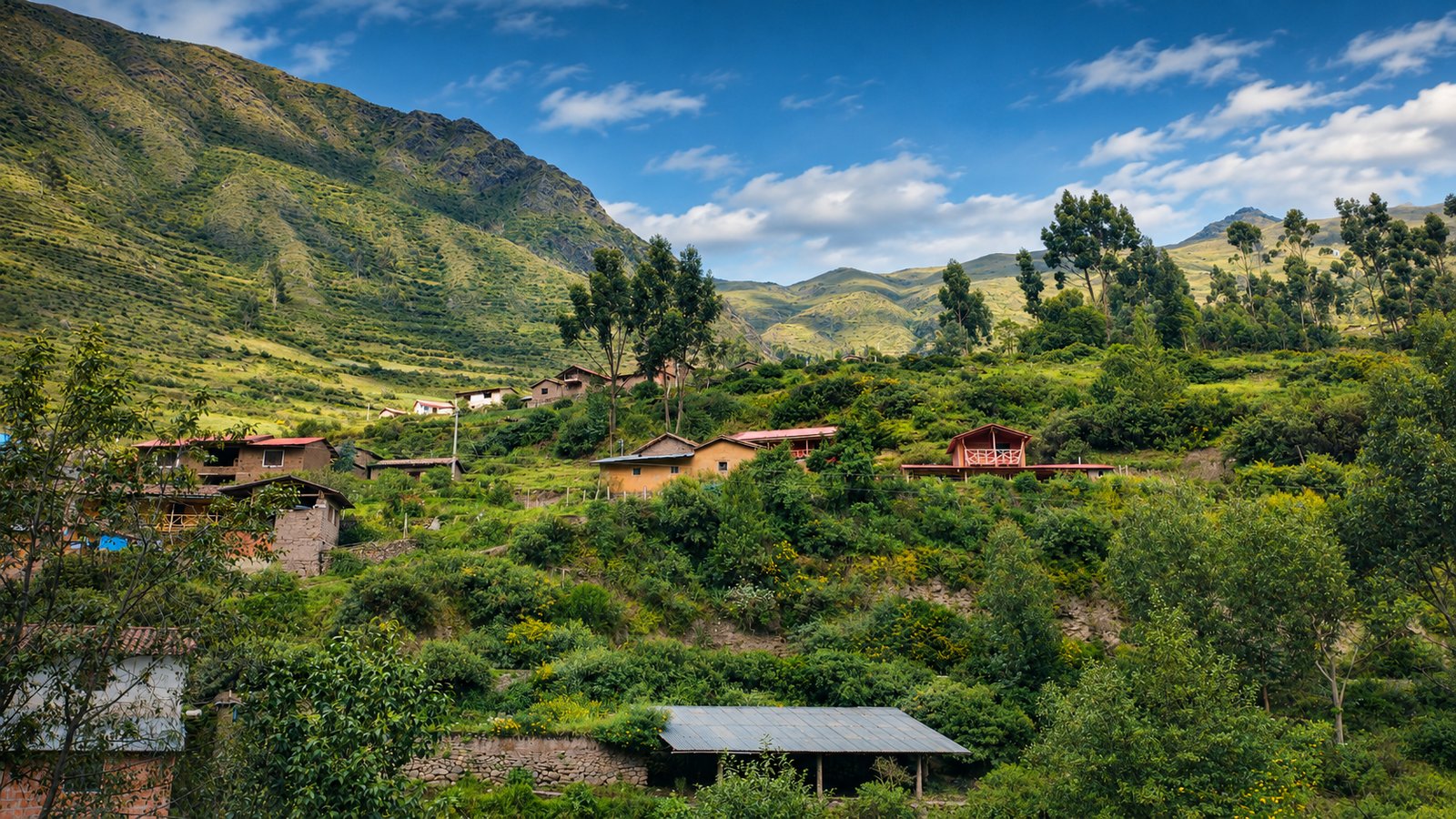
Huilloc offers homes, potable-water services and working agriculture in a high Andean valley. Its rough-road approach gives some separation, but the inhabited village and its fields remain open ground that a small community must use carefully.
Image credit

Overall
4.7 out of 10Defensibility
2 out of 10Isolation
4 out of 10Sustainability
8 out of 10Ranking context
How this base ranks
Global
#50 of 88 · Top 57%
Region · South America
#5 of 7 · Top 71%
Base Type · Remote Settlement
#10 of 16 · Top 63%
Field assessment
At a glance
Bottom Line
A promising place to continue everyday rural life, provided the group can protect essential journeys and sustain local water and farming routines without assuming the village population joins it.
Biggest Trade-off
The fields and livestock that offer resource renewal also draw people out from sheltered homes into an open settlement.
Most Likely Failure
Pressure on paths between homes, water and fields disrupts routine work, reducing the village resource advantage even while shelter and farmland remain physically intact.
Score rationale
Why it scores this way
Defensibility · 2/10
Huilloc is an open agricultural village. Valley slopes shape movement, but scattered homes, fields and connecting paths give a small group more ground to cover than a single defended compound.
Advantages
- The constrained valley helps focus observation on major movements towards the occupied area.
Limitations
- Watching the vehicle road does not secure local paths or the people working away from shelter.
Isolation · 4/10
The high valley and rough final road give useful separation from larger towns. Huilloc nevertheless has an established resident population and a direct road connection to Ollantaytambo, so it cannot be treated as empty wilderness.
Advantages
- The rough approach adds a physical obstacle between the village and ordinary regional traffic.
Limitations
- Local population and movement inside the village still require assessment; distance from town cannot establish a clean start.
Sustainability · 8/10
Homes, potable water, sanitation, local food preparation and active farming provide a mature rural habitat. Keeping that habitat productive requires water care, husbandry and seasonal work as well as enough beds.
Advantages
- Existing crops and livestock provide practical routes towards replacing food consumed from stores.
Limitations
- Documented agriculture does not establish the available harvest, usable stock or skills of the particular survivor group.
Survival horizons
How survival changes over time
Connect shelter with essentials
First 7 Days
Check water delivery and sanitation, identify accessible food and choose homes with manageable journeys to daily work. Observe the road and local paths before dispersing across the settlement.
Positive factors
- Family lodging and existing domestic services give the group a functioning settlement layout to work with.
Risks
- The village’s size can encourage overextension before nearby residents, routes and service condition are understood.
Keep the village routines working
First 100 Days
Track consumption against actual crop and livestock availability. Organise water upkeep, food preparation and field work alongside watches, learning what can be maintained with ordinary tools and the people available.
Positive factors
- Local cultivation and livestock offer productive tasks that can contribute beyond the initial household inventory.
Risks
- A missed work cycle or unsafe route to fields can reduce food availability without any failure of the buildings themselves.
Carry production into another cycle
Long Term
Endurance depends on continuing cultivation, husbandry and safe water through successive cycles. Huilloc has established local pathways, but replacement tools, fuel, service components and an adequate diet still need assessment as outside supply becomes unreliable.
Positive factors
- Traditional domestic fabric and locally administered services offer useful functions that do not all depend on specialist industrial plant.
Risks
- Labour shortages and disrupted field access can erode renewal; agriculture on the map is not food secured for the next season.
Visual survey
Gallery
Location context
The Lay of the Land
Tactical assessment
Practical Reality
Best Use
Choose a compact living area near verified water and practical access to community fields. Coordinate watches with water collection, crop work and animal care rather than trying to guard every home.
Strengths
- Existing homes, family lodging and toilets support domestic organisation without first building a mountain camp.
- Potato, oca and barley cultivation alongside livestock offers actual local production rather than food retail alone.
- Potable-water provision and a recognised community sanitation board establish a locally managed service to inspect and maintain.
Key Risk
Food renewal requires repeated outdoor work. Splitting a small group between watches, cultivation, livestock and water maintenance can leave both daily tasks and local routes underprotected.
Weaknesses
- Homes, internal paths and fields lack a continuous fortified boundary that a small group can hold.
- A rough vehicle road connects the settlement to Ollantaytambo; mountain scenery does not make Huilloc unreachable.
- Cultivation and animal care require continued labour outside the occupied homes, with fuel and manufactured supplies still dependent on wider networks.
Reality Check & Constraints
An established farming community demonstrates real habitat and local production, not an automatic transfer of farming knowledge or a guaranteed harvest. Current services still need people, maintenance and usable inputs.
Assumptions / constraints
- Twenty capable adults remain the reference group. Existing residents are neither assumed absent nor credited as extra defenders, farmers or water operators.
- The OD-005 Huilloc settlement and its community operating area remain the Base; Ollantaytambo and other valley communities are external.
- Water-system condition, accessible tools and stocks, crop stage, animal availability and the group’s farming competence must be checked. No harvest quantity or survival duration is guaranteed.
Decision context
Rivals / Alternatives
Similar rival
Shirakawa-go
Japan · Remote Settlement
Shirakawa-go keeps the same remote settlement strategy, with only 0.0 points between the overall scores and closely matched defensibility pressure.
Overall 4.7/10
Strongest alternative
Isle of Eigg Village
United Kingdom · Remote Settlement
Isle of Eigg Village scores 6.3 overall versus 4.7, adding a stronger isolation profile while staying relevant as another remote settlement.
Overall 6.3/10
Wildcard rival
Fort Jefferson
United States · Fortified Structure
Fort Jefferson changes the strategy: it is built around the fortified structure strategy with a defensibility edge, while Huilloc Village holds more of the sustainability advantage.
Overall 6.7/10