North America · Subterranean
Cheyenne Mountain Complex
United States
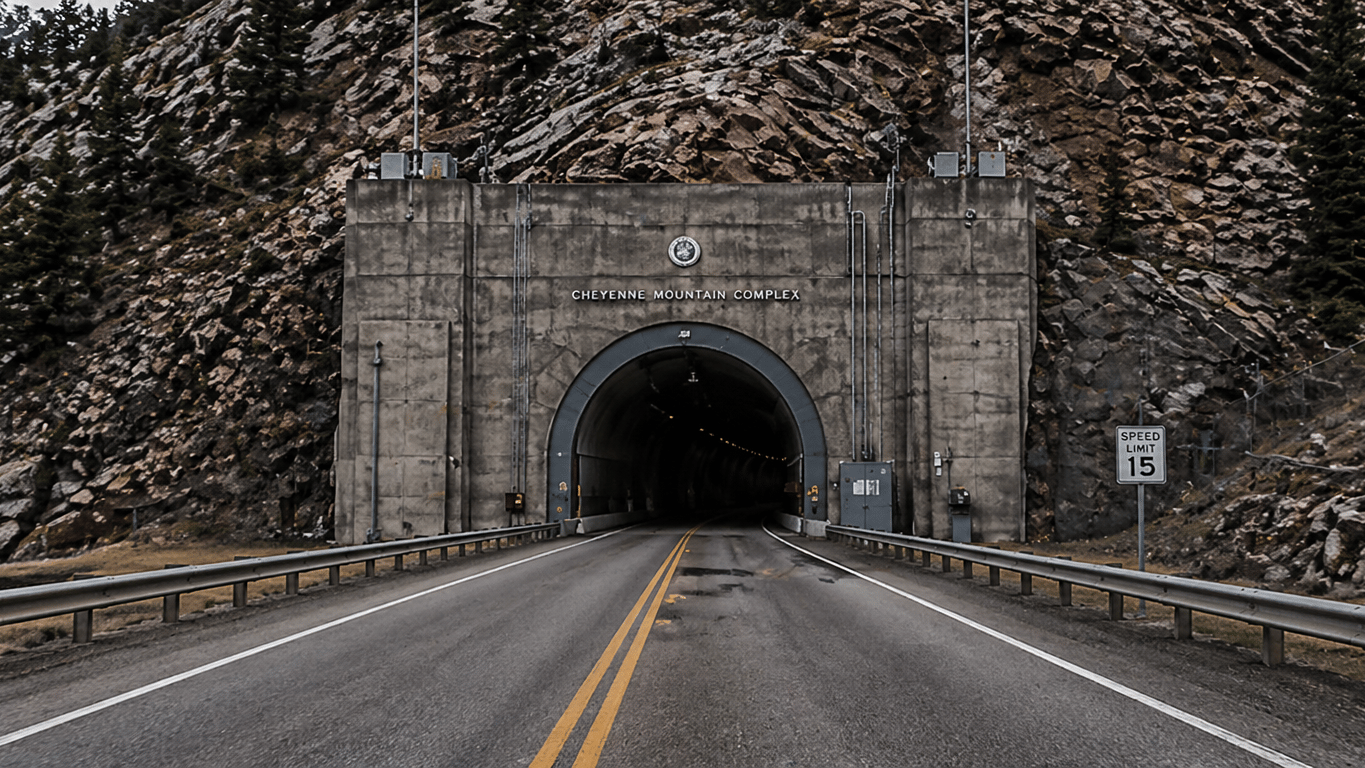
Cheyenne Mountain combines granite protection, blast doors and extensive underground rooms near Colorado Springs. Twenty survivors gain exceptional physical shelter, but prolonged occupation depends on complex air, water and power systems they may not sustain.
Overall
5.7 out of 10Defensibility
10 out of 10Isolation
2 out of 10Sustainability
5 out of 10Ranking context
How this base ranks
Global
#20 of 88 · Top 23%
Region · North America
#4 of 9 · Top 44%
Base Type · Subterranean
#3 of 10 · Top 30%
Field assessment
At a glance
Bottom Line
The doors solve an entry problem; staying safely behind them requires an operating life-support system and a group able to maintain it.
Biggest Trade-off
Exceptional physical protection concentrates the group inside a technically demanding habitat, close to a large urban population.
Most Likely Failure
A power or ventilation fault undermines safe occupation behind intact blast doors, forcing a decision about access while outside pressure remains unresolved.
Score rationale
Why it scores this way
Defensibility · 10/10
Granite, blast doors and hardened internal buildings protect the occupied boundary. Their physical strength remains distinct from the ability to live safely inside or manage an internal infection.
Advantages
- Documented manual blast-door fallback adds an alternative to hydraulic closure without requiring new defensive construction.
Limitations
- Door control still requires deliberate access management; barriers cannot isolate a threat already sharing occupied rooms.
Isolation · 2/10
Mountain terrain provides local separation, but Colorado Springs lies nearby. The portal concentrates contact at the site; it does not make the surrounding region remote.
Advantages
- The underground setting separates occupied rooms from ordinary surface circulation.
Limitations
- Road access links the station to a substantial nearby population source even when the interior is well protected.
Sustainability · 5/10
Internal buildings, reservoirs and engineered services offer a credible habitat framework. Keeping people underground nevertheless requires working air, power and water systems rather than floor space alone.
Advantages
- Extensive enclosed rooms provide room to organize a small group within the existing complex.
Limitations
- Sealed operation intensifies reliance on specialist systems; current public evidence does not prove ordinary-survivor maintainability.
Survival horizons
How survival changes over time
Verify life behind the doors
First 7 Days
Establish controlled entry, inspect occupied rooms and identify essential air, water and power dependencies. Confirm usable reserves before relying on the complex as a sealed refuge.
Positive factors
- Existing hardened access geometry lets entry control begin without building a new perimeter.
Risks
- Closing doors is not evidence that internal services can sustain twenty people safely.
Manage linked systems
First 100 Days
Follow consumption, routine maintenance and warning signs across ventilation, generation, water and cooling. Share what the group can learn without assuming specialist repairs are achievable.
Positive factors
- Documented internal plant provides systems to assess rather than a requirement to create every service from scratch.
Risks
- A fault in one essential system can burden others while replacement parts and outside help become less available.
Shelter is not renewal
Long Term
Continued residence requires maintainable services and recurring food and consumable inputs. Finite reserves cannot establish an autonomous underground settlement.
Positive factors
- The protective shell retains value even as the group reassesses which internal spaces it can support.
Risks
- No durable internal food-production pathway is evidenced, and technical support cannot be replaced simply by reducing occupancy.
Visual survey
Gallery
Location context
The Lay of the Land
Tactical assessment
Practical Reality
Best Use
Occupy only rooms whose air, water and power dependencies the group understands, keeping portal control separate from decisions about prolonged sealed operation.
Strengths
- Granite shielding and massive blast doors provide substantial passive protection at the underground occupied boundary.
- Portal and tunnel geometry concentrates entry, reducing the number of routes the group must observe directly.
- Internal reservoirs and generator infrastructure provide existing resource facilities, with usable contents and condition still requiring verification.
Key Risk
The systems that make underground occupation possible normally receive specialist engineering support; twenty capable adults do not automatically replace that workforce.
Weaknesses
- Colorado Springs is nearby: mountain enclosure does not remove the surrounding regional population source.
- Air handling, power, water and cooling form an operating system whose failures can affect habitability together.
- Extensive workspace and a large normal workforce do not demonstrate residential independence or renewable food provision.
Reality Check & Constraints
The approved model uses twenty capable adults, not trained military engineers. Public descriptions establish installed systems, not current reserves, serviceability or a guaranteed sealed endurance.
Assumptions / constraints
- The twenty survivors receive no automatic specialist crew, military staffing, off-site facilities or dependable external supply.
- Reservoir water, diesel, food and plant condition are unquantified; no published capacity is converted into a survival duration.
Decision context
Rivals / Alternatives
Similar rival
Hackenberg Maginot Fortress
France · Subterranean
Hackenberg Maginot Fortress keeps the same subterranean strategy, with only 0.3 points between the overall scores and closely matched sustainability pressure.
Overall 6/10
Strongest alternative
Olavsvern Naval Base
Norway · Subterranean
Olavsvern Naval Base scores 6.3 overall versus 5.7, adding a stronger sustainability profile while staying relevant as another subterranean.
Overall 6.3/10
Wildcard rival
Waw an Namus Caldera
Libya · Natural Landform
Waw an Namus Caldera changes the strategy: it is built around the natural landform strategy with a isolation edge, while Cheyenne Mountain Complex holds more of the defensibility advantage.
Overall 4.3/10