Polar/Arctic · Institutional Compound
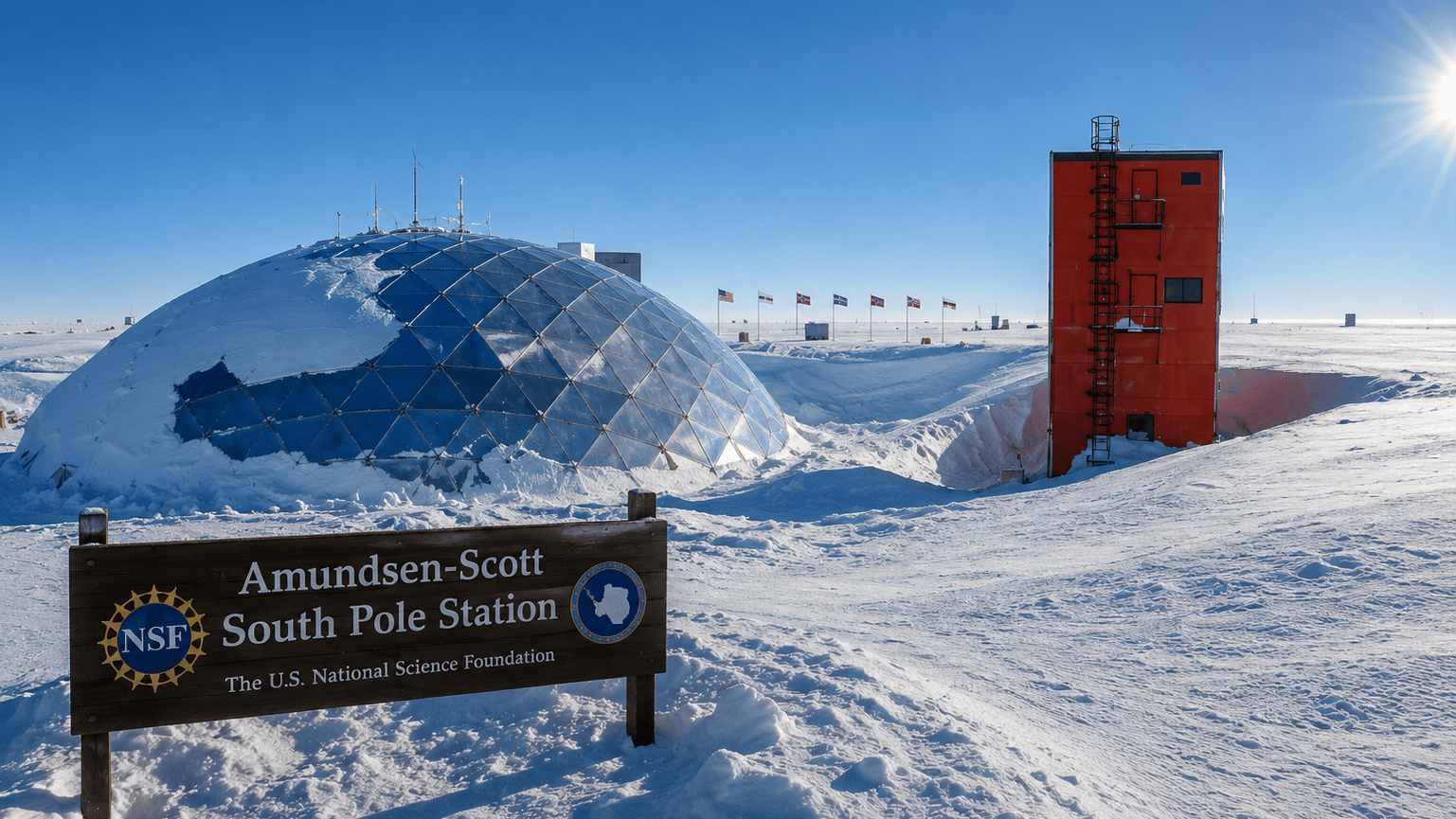
Amundsen-Scott South Pole Station
Antarctica
Amundsen-Scott South Pole Station puts an enormous Antarctic distance between twenty survivors and population centres. Its elevated living space, kitchens, medical facilities and utility plant are substantial, but the heat, electricity and melted-ice water systems require fuel, maintenance and specialist operation.
Overall
7.7 out of 10Defensibility
4 out of 10Isolation
10 out of 10Sustainability
9 out of 10Ranking context
How this base ranks
Global
#1 of 88 · Top 1%
Region · Polar/Arctic
#1 of 3 · Top 33%
Base Type · Institutional Compound
#1 of 6 · Top 17%
Field assessment
At a glance
Bottom Line
Exceptional isolation and a real polar habitat make a short-term refuge credible only while station utilities remain serviceable. Endurance is bounded by fuel, spares and the ability to keep complex systems running without seasonal resupply.
Biggest Trade-off
The distance that makes outside contact unlikely also makes spare parts, technicians and replacement fuel extraordinarily hard to obtain after logistics stop.
Most Likely Failure
A prolonged generator, fuel-handling or Rodwell fault outlasts the twenty-person group’s repair stock or technical skill; heat and safe water fail before geographic isolation becomes an advantage.
Score rationale
Why it scores this way
Internal fallback, not a hardened fort · 4/10
The elevated station and sealed-pod contingency create some workable access and habitation separation.
Analysis
An elevated main building, vertical connections and the documented Pod B contingency can help a small group focus access and isolate occupied functions. There is no evidence here of a hardened perimeter or a defended anti-intrusion design. External long sightlines are useful only if personnel can maintain a watch.
Evidence framing
NSF documents the structure and emergency fallback; current operation of those specific systems remains unverified.
Advantages
- Elevated occupied rooms and internal connecting points reduce uncontrolled movement into sleeping and utility areas.
Limitations
- No established hardened perimeter; wide exposed approaches demand observation rather than confidence in static defences.
Isolation also isolates repairs · 10/10
The plateau separates the group from outside pressure but eliminates ordinary alternatives.
Analysis
At 90 degrees south there is no nearby civilian road, farm or town to fall back to. A group gains warning and distance from most human-origin threats, but it also loses practical access to replacement parts and aid. Isolation is a property of location, not a source of heat or calories.
Evidence framing
NSF station access depends on seasonal aircraft and traverses from McMurdo; neither is guaranteed under the survival scenario.
Advantages
- Exceptional geographic distance sharply limits routine arrival by outside groups.
Limitations
- The same distance removes quick evacuation, reinforcements and outside technical recovery.
Habitat quality depends on uptime · 9/10
The station is designed for continuous human occupation, with all essential services mechanised.
Analysis
Existing housing, kitchens, medical spaces, power and meltwater plant make the station much more credible for twenty people than an improvised polar camp. Those advantages require triage: concentrate rooms, protect fuel and heat loads, test the water pathway, and identify who can repair the plant. A food-growth chamber supplements facility capability but is not evidence of calorie self-sufficiency.
Evidence framing
NSF capacity and infrastructure documentation confirms the built systems, not post-collapse consumable inventories or failure-free operation.
Advantages
- Year-round occupied infrastructure already accommodates more than twenty in documented winter conditions.
Limitations
- Heat, electricity, water, waste and food supply can fail in a cascade if mechanical inputs or fuel stop.
Survival horizons
How survival changes over time
First seven days — prove life support
First 7 Days
Inventory heat, fuel, power redundancy, the Rodwell and treatment train before deciding which occupied pod can safely hold twenty.
Positive factors
- A purpose-built winter habitat provides a credible initial shelter if critical systems remain functioning.
Risks
- An unverified generator, water pump or fuel feed can make an otherwise intact building nonviable within days.
First hundred days — reduce load, protect expertise
First 100 Days
Operate a smaller heated footprint, document preventive maintenance and ration consumables against actual inventories rather than theoretical storage volume.
Positive factors
- Housing and kitchen capacity already exceed the reference group; redundancy may permit selective load reduction.
Risks
- The need for complex repairs and replacement parts grows while normal summer supply flights and traverses may not occur.
Long term — dependency becomes decisive
Long Term
Survival eventually turns on fuel, food, spares, specialist skills and Rodwell longevity; none can be presumed renewable simply because the installation is remote.
Positive factors
- Isolation continues to suppress most outside encounters for as long as station services work.
Risks
- An unrepaired mechanical failure could extinguish heat or safe water with no nearby fallback settlement.
Visual survey
Gallery
Location context
The Lay of the Land
Tactical assessment
Practical Reality
Best Use
Keep the occupied footprint to the most maintainable portion of the elevated station, preserve monitored power and heat, verify water-treatment operation and use the documented Pod B winter fallback only if its emergency systems are actually available.
Strengths
- The geographic South Pole is exceptionally far from population centres and ordinary road travel.
- NSF documents purpose-built lodging, dining, medical, utility and research facilities with winter staff capacity above twenty.
- An elevated building and documented sealable Pod B fallback offer useful internal separation if present systems are operational.
Key Risk
The entire settlement depends on engineered warmth, generators, fuel, Rodwell water pumping and waste treatment in an environment with no natural habitable fallback.
Weaknesses
- Water production relies on the Rodwell, pumps, treatment and skilled maintenance rather than a low-tech liquid-water source.
- Fuel, food and critical parts normally arrive through highly seasonal, specialised external logistics.
- The polar climate makes failed heat, power or sewage management a life-safety event, not an inconvenience.
Reality Check & Constraints
NSF confirms year-round habitation, storage and winter staff capacity, not the accessible food, fuel, medical supplies or specialist skill that a newly arrived twenty-person group would inherit. Seasonal aircraft and traverses are not guaranteed after collapse.
Assumptions / constraints
- Exactly twenty capable adults use the occupied station; we do not assume functioning stocks, a qualified maintenance crew or resupply beyond the verified current infrastructure.
Decision context
Rivals / Alternatives
Similar rival
McMurdo Station
Antarctica · Fortified Structure
McMurdo Station keeps the same Polar/Arctic risk context, with only 1.0 points between the overall scores and closely matched defensibility pressure.
Overall 6.7/10
Strongest alternative
Danum Valley Field Centre
Malaysia · Institutional Compound
Danum Valley Field Centre is the strongest relevant peer available at 6.0 overall versus 7.7, without a higher headline-pillar score.
Overall 6/10
Wildcard rival
Great Mosque of Djenné
Mali · Landmark Structure
Great Mosque of Djenné changes the strategy: it is built around the landmark structure strategy without a headline-pillar edge over Amundsen-Scott South Pole Station, while Amundsen-Scott South Pole Station holds more of the isolation advantage.
Overall 1.3/10