Middle East · Fortified Structure
Krak des Chevaliers
Syria
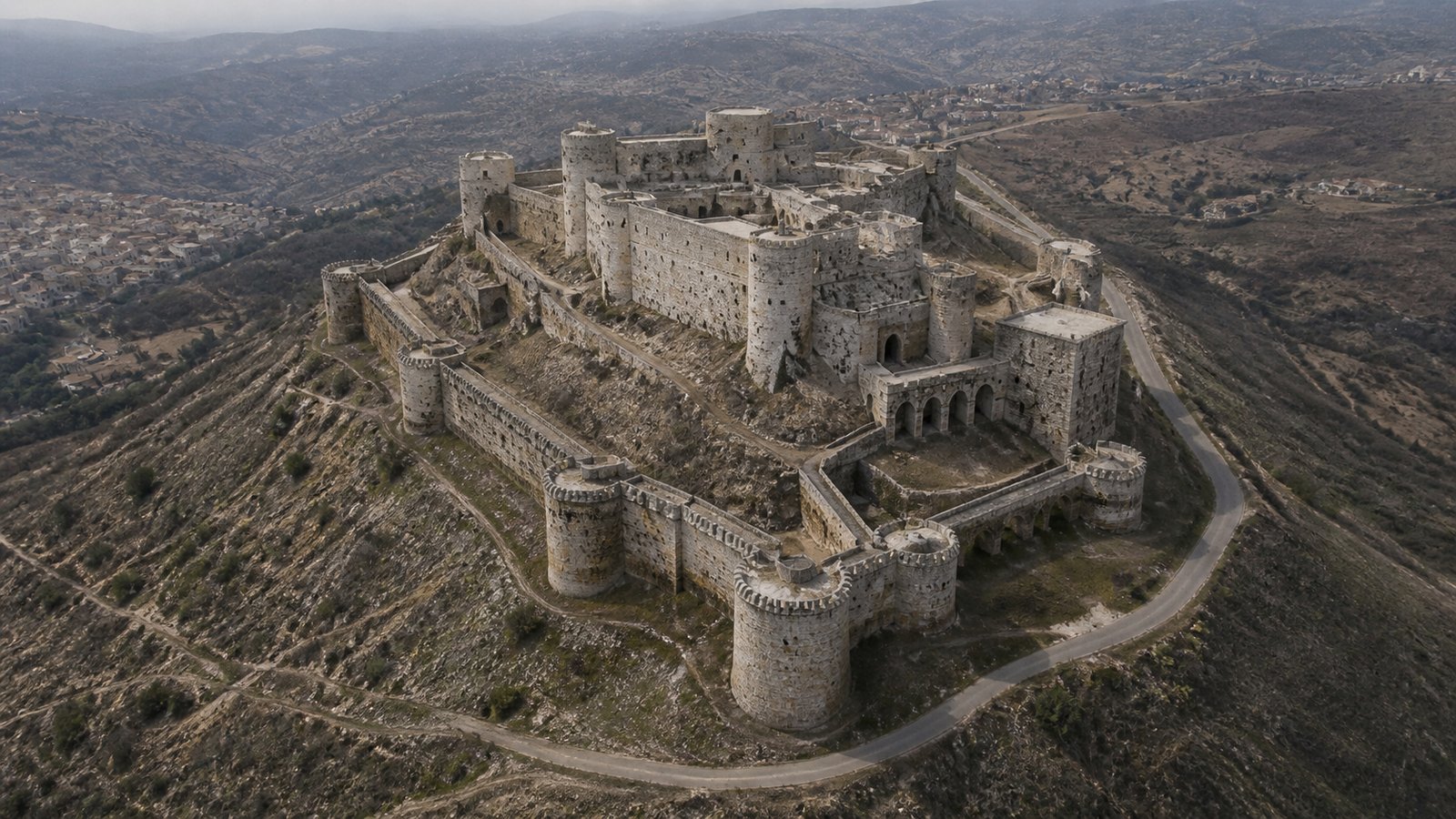
Krak des Chevaliers offers layered ridge-top defences, substantial halls and integrated cistern architecture. Holding the fortress is a stronger proposition than living independently inside it: present water supply, sanitation and food renewal remain unproven.
Overall
5 out of 10Defensibility
8 out of 10Isolation
4 out of 10Sustainability
3 out of 10Ranking context
How this base ranks
Global
#35 of 88 · Top 40%
Region · Middle East
#4 of 5 · Top 80%
Base Type · Fortified Structure
#10 of 18 · Top 56%
Field assessment
At a glance
Bottom Line
A strong defensive refuge whose practical limit is daily provision. The group needs verified water and usable living arrangements before relying on the castle for extended occupation.
Biggest Trade-off
The walls protect the occupied position, but obtaining supplies outside them would expose people to the settled landscape the fortress overlooks.
Most Likely Failure
Unverified cistern water proves unusable or insufficient, forcing repeated supply trips beyond the defences.
Score rationale
Why it scores this way
Defensibility · 8/10
The ridge, layered walls and controlled entrance sequence provide strong passive resistance and fallback. The practical task is to use sound defensive depth while recognising areas still needing conservation.
Advantages
- An outer problem need not immediately remove every protected internal position.
Limitations
- Historic completeness cannot replace an inspection of present wall, gate and structural condition.
Isolation · 4/10
Elevation separates the final approach, but nearby al-Hosn and regional roads keep the castle connected to a settled landscape. Its height contributes more to observation and defence than deep remoteness.
Advantages
- The ridge gives useful local separation from activity immediately below.
Limitations
- People can still reach the vicinity through the surrounding settlement and road network.
Sustainability · 3/10
Large enclosed spaces give twenty people room, but continued habitation also requires safe sleeping areas, waste handling and food preparation. Surviving halls establish shelter potential rather than a complete residential system.
Advantages
- Internal volume allows essential activities to be separated where the fabric is sound.
Limitations
- A defensible hall can remain a poor living space if daily sanitation and potable water are unresolved.
Survival horizons
How survival changes over time
Inspect the refuge
First 7 Days
Check accessible defences, safe rooms and the actual cistern contents before distributing supplies or assigning watches. Water verification should proceed alongside securing the entrance, not wait until shelter feels settled.
Positive factors
- Layered masonry offers an established defensive framework without constructing new fortifications.
Risks
- An impressive storage vault may contain no usable drinking reserve; its present state is unconfirmed.
Keep daily life inside
First 100 Days
As provisions are consumed, repeatable water, hygiene and food routines become decisive. Record what can actually be maintained indoors and how often essential tasks force people outside the defended area.
Positive factors
- Substantial halls and courtyards provide room to organise activities within the existing works.
Risks
- Repeated external collection would spend the protection gained from strong walls on exposed supply journeys.
Renew beyond stored reserves
Long Term
Lasting occupation requires reliable cistern replenishment and treatment, continuing food provision and care of the surviving fabric. Restoration progress does not establish that a small unaided community can sustain these functions.
Positive factors
- Passive masonry and ridge geometry retain defensive value without continuous powered operation.
Risks
- Finite consumables and specialist structural needs can undermine a refuge that remains physically hard to approach.
Visual survey
Gallery
Location context
The Lay of the Land
Tactical assessment
Practical Reality
Best Use
Inspect the gate sequence, safe interior rooms and cistern condition, then concentrate occupation around verified essentials. Retain the surviving fortress boundary without assuming neighbouring farmland becomes its supply base.
Strengths
- Concentric defensive works give more than one protective layer if an outer position becomes unsafe.
- The commanding ridge supports observation of final approaches.
- Surviving halls and courtyards offer substantial space for separating living, storage and work.
Key Risk
Structural conservation and daily water management require different skills; a small group may have ample protected space while lacking the means to keep it safe and habitable.
Weaknesses
- Conservation needs prevent assuming every wall, roof and internal route is equally sound.
- Water-storage architecture does not establish safe water available for consumption.
- Food preparation, sanitation and year-round residential service for the group remain unestablished.
Reality Check & Constraints
Restoration confirms surviving halls and water-storage fabric, not a stocked medieval garrison or a working modern residence. Cistern quantity, potability, replenishment and treatment still need verification.
Assumptions / constraints
- Al-Hosn and external agriculture remain surroundings, not guaranteed controlled supply territory.
- The cistern is credited as surviving infrastructure without inventing contents, treatment or seasonal refill.
- Twenty capable adults do not inherit a historic garrison, modern service staff or specialist conservation team.
Decision context
Rivals / Alternatives
Similar rival
Masada
Israel · Fortified Structure
Masada keeps the same fortified structure strategy, with only 1.0 points between the overall scores and closely matched isolation pressure.
Overall 6/10
Strongest alternative
Fort George
United Kingdom · Fortified Structure
Fort George scores 6.7 overall versus 5.0, adding a stronger sustainability profile while staying relevant as another fortified structure.
Overall 6.7/10
Wildcard rival
Amundsen-Scott South Pole Station
Antarctica · Institutional Compound
Amundsen-Scott South Pole Station changes the strategy: it is built around the institutional compound strategy with a sustainability edge, while Krak des Chevaliers holds more of the defensibility advantage.
Overall 7.7/10