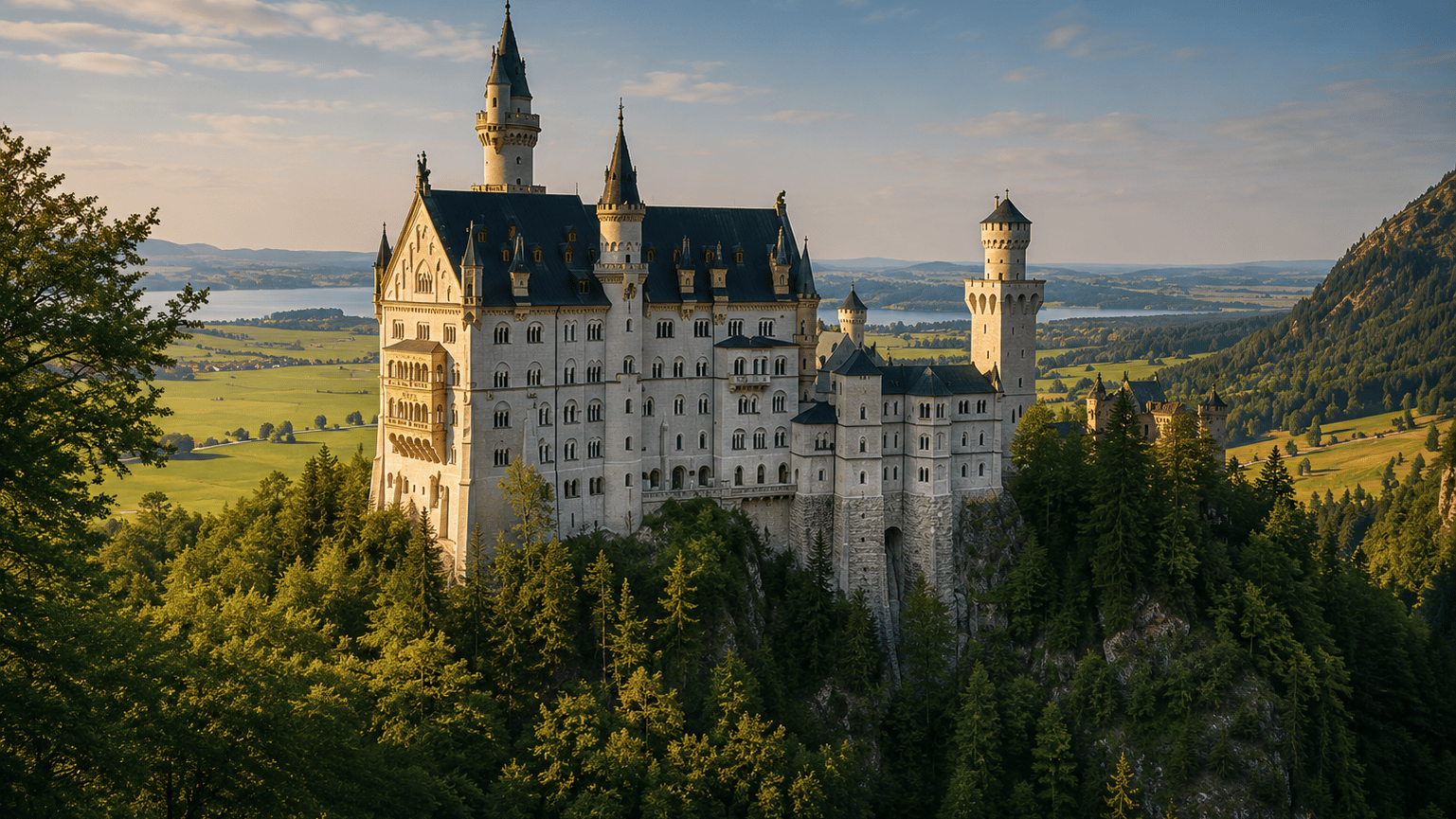
Western Europe · Elevated Stronghold
Neuschwanstein Castle
Germany
Neuschwanstein offers substantial indoor shelter above steep approaches, with current toilets and a cafe inside the castle. Its towers promise more than the evidence establishes: this royal retreat depends on outside provision and specialist upkeep, rather than operating as an autonomous mountain fortress.
Overall
4.7 out of 10Defensibility
5 out of 10Isolation
3 out of 10Sustainability
6 out of 10Ranking context
How this base ranks
Global
#52 of 88 · Top 59%
Region · Western Europe
#5 of 9 · Top 56%
Base Type · Elevated Stronghold
#8 of 13 · Top 62%
Field assessment
At a glance
Bottom Line
A useful sheltered refuge with observable approaches, provided daily water, warmth and sanitation can be maintained. The building gives ample space, but its appearance does not establish military breach resistance or independent supplies.
Biggest Trade-off
The steep ascent helps limit incoming movement while making every external delivery and evacuation harder. Nearby village services are convenient in normal operation but remain outside the castle's protection.
Most Likely Failure
Water, heating or sanitation loss forces supply journeys down the steep approach and reduces habitable space. Continued shelter then depends on repairs or external provision the group may be unable to sustain.
Score rationale
Why it scores this way
Defensibility · 5/10
Masonry, gateways, courtyards and steep access provide useful resistance around the building. As a royal retreat rather than a military fortress, it has no verified complete system of hardened gates and internal fallback compartments.
Advantages
- The gateway and courtyards give defined places to organise controlled entry.
Limitations
- Decorative towers and robust walls do not certify the resistance of each usable entrance.
Isolation · 3/10
The uphill approach creates local separation above Hohenschwangau. Roads and public transport connect the village to the wider region, so the castle's elevated position provides warning more readily than remoteness.
Advantages
- The final steep journey adds a physical obstacle before contact with the occupied building.
Limitations
- Established upper and lower approaches remain accessible pedestrian routes.
Sustainability · 6/10
A maintained weatherproof building, current toilets and cafe support credible daily occupation. Historic domestic systems add useful fabric to inspect, but continued warmth, cooking and hygiene cannot be inferred from their original installation.
Advantages
- Enclosed space allows basic household separation without constructing new shelter.
Limitations
- Passenger lifts and managed visitor services require power, maintenance and competent operation.
Survival horizons
How survival changes over time
Inspect the domestic essentials
First 7 Days
Check usable rooms, water, toilets and stair exits, then inventory accessible food and equipment. Establish entry routines around inspected doors rather than assuming the castle silhouette supplies a defensive plan.
Positive factors
- Existing indoor facilities provide a sheltered setting for initial organisation.
Risks
- A lift-dependent living arrangement leaves evacuation vulnerable to power or equipment loss.
Services narrow the occupation
First 100 Days
Track supplies and the condition of water, sanitation and occupied rooms. If services fail, reduce the usable footprint and assess carrying journeys honestly; the surrounding visitor economy is not a guaranteed resupply system.
Positive factors
- The passive building shell retains shelter value when some modern systems stop.
Risks
- Supply trips down the steep approach take people away from watches and household upkeep.
Maintain more than appearances
Long Term
Long residence requires repeatable safe water and food, dependable domestic services and structural problems the group can manage. The documented need for specialist rock and foundation care limits confidence in simply occupying the building indefinitely.
Positive factors
- Maintained masonry and constrained approaches retain useful shelter and warning.
Risks
- Deferred specialist work can reduce safe occupancy even before stores or ordinary repairs become decisive.
Visual survey
Gallery
Location context
The Lay of the Land
Tactical assessment
Practical Reality
Best Use
Choose habitable rooms linked to inspected toilets, water and safe stair routes. Watch both lower and upper pedestrian approaches, and keep an evacuation plan that does not require the passenger lift.
Strengths
- Steep final pedestrian approaches concentrate movement before it reaches the castle.
- Existing rooms and courtyards provide space to separate sleeping, stores and work.
- Current in-castle toilets and support areas offer practical facilities to inspect immediately.
Key Risk
Current visitor services and historic plumbing do not prove a protected independent drinking-water supply, fuel reserve or functioning residential kitchen after outside support fails.
Weaknesses
- Hohenschwangau and regional transport connections lie close below the final ascent.
- Foundation, rock-face and facade maintenance include tasks beyond ordinary general repairs.
- No independent food, water or survival-energy renewal is established within the castle.
Reality Check & Constraints
Visitor throughput measures managed access, not overnight residence. The ornate shell conceals a documented need for foundation monitoring, rock-face securing and facade work that ordinary household repairs cannot fully replace.
Assumptions / constraints
- Only the castle and integrated final approach are occupied assets; village, ticket centre and neighbouring castles are excluded.
- Historic heating, kitchen and plumbing are not assumed currently operable or independent.
- Twenty capable adults can organise watches and routine upkeep without inheriting palace staff or specialist engineers.
Decision context
Rivals / Alternatives
Similar rival
Rocamadour
France · Elevated Stronghold
Rocamadour keeps the same elevated stronghold strategy, with only 0.0 points between the overall scores and closely matched defensibility pressure.
Overall 4.7/10
Strongest alternative
Mont Saint-Michel
France · Fortified Structure
Mont Saint-Michel scores 6.3 overall versus 4.7, adding a stronger defensibility profile while staying relevant as a Western Europe option.
Overall 6.3/10
Wildcard rival
Amundsen-Scott South Pole Station
Antarctica · Institutional Compound
Amundsen-Scott South Pole Station changes the strategy: it is built around the institutional compound strategy with a isolation edge, while Neuschwanstein Castle holds more of the defensibility advantage.
Overall 7.7/10