Eastern Europe · Fortified Structure
Malbork Castle
Poland
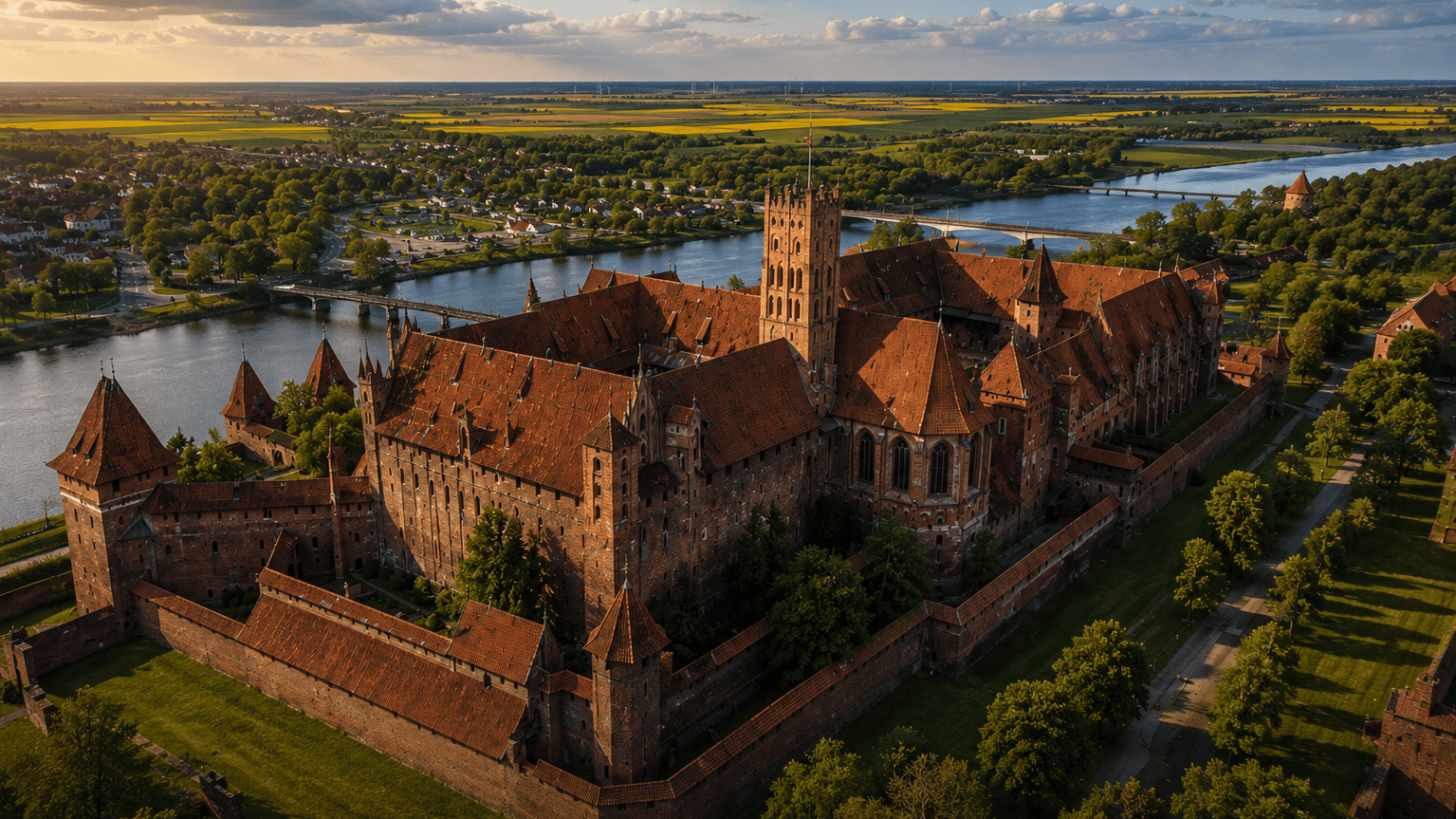
Malbork Castle offers nested walls, moats and substantial indoor space beside the Nogat. The fortress sits within a modern town: its strongest protection begins at the perimeter, while water, food and maintained services still depend heavily on outside systems.
Overall
4.3 out of 10Defensibility
8 out of 10Isolation
1 out of 10Sustainability
4 out of 10Ranking context
How this base ranks
Global
#62 of 88 · Top 70%
Region · Eastern Europe
#9 of 10 · Top 90%
Base Type · Fortified Structure
#15 of 18 · Top 83%
Field assessment
At a glance
Bottom Line
A strong enclosed refuge under nearby pressure, with room to fall back inside. Lasting occupation depends on keeping a manageable residential area supplied rather than trying to operate the entire museum complex.
Biggest Trade-off
Layered fortifications offer substantial protection, but the urban setting gives little regional buffer. A small group must maintain daily life while pressure can gather immediately outside.
Most Likely Failure
Utility or supply failure forces regular trips into the surrounding town, exposing people and weakening watches while the masonry itself remains protective.
Score rationale
Why it scores this way
Defensibility · 8/10
Walls, moats, gate passages and successive castle layers provide substantial resistance and internal fallback. Their scale also requires selective occupation: a strong inner position does not make every outer connection secure.
Advantages
- Nested boundaries provide more recovery options than a single breached enclosure.
Limitations
- Unwatched connections can undermine the benefit of defensive depth.
Isolation · 1/10
Malbork is an urban fortress, with the town immediately around it. The Nogat and moats complicate local contact; they do not separate the Base from the wider population that generates pressure.
Advantages
- The riverside frontage removes some ordinary landward approaches.
Limitations
- Other sides remain connected to the surrounding town and its movement network.
Sustainability · 4/10
Museum rooms, sanitation and extensive service spaces offer a substantial indoor foothold. Current residential heating, cooking and medical support are less certain, so usable shelter should be judged room by room rather than by historic capacity.
Advantages
- Existing enclosed accommodation allows basic routines without first constructing shelter.
Limitations
- Working visitor facilities depend on water, upkeep and services the group may not sustain alone.
Survival horizons
How survival changes over time
Occupy one workable area
First 7 Days
Inspect gates, room condition, toilets and water access, then link a compact living area to clear fallback routes. Inventory accessible provisions without assuming that historic storage buildings contain them.
Positive factors
- Walls and enclosed rooms provide immediate options for separation and shelter.
Risks
- Trying to hold every castle layer at once consumes people needed for ordinary daily tasks.
Services become the workload
First 100 Days
As supplies diminish, track water reliability, waste handling and the condition of occupied rooms. Keep external trips distinct from routine internal movement, with their staffing cost included in the watch plan.
Positive factors
- Durable masonry continues to shelter the occupied area as modern support becomes less reliable.
Risks
- Failed services may force more urban contact before any defensive wall fails.
A fortress needs renewal
Long Term
Continued residence requires repeatable potable water, food replacement and manageable upkeep. Storage space helps organise resources, but there is no established independent production system inside the evaluated complex.
Positive factors
- Internal depth remains useful even if only part of the complex stays habitable.
Risks
- Deferred conservation and scarce repair materials can progressively reduce safe space and usable services.
Visual survey
Gallery
Location context
The Lay of the Land
Tactical assessment
Practical Reality
Best Use
Choose a compact occupied area linked to inspected sanitation and water access. Use the nested castles as fallback options, keeping journeys to stores and essential services within the monitored footprint.
Strengths
- Separate castle layers permit fallback without immediately abandoning the whole refuge.
- Enclosed rooms allow sleeping, stores and work to occupy different spaces.
- Existing toilets and water distribution offer a practical starting point for daily organisation.
Key Risk
The museum water network and food-service premises are useful infrastructure, but neither establishes potable-water independence, durable provisions or renewable food within the walls.
Weaknesses
- Nearby urban population pressure can reach the outer boundary without a remote approach journey.
- The complex is too extensive to treat every gate, courtyard and room as continuously watched.
- Specialist conservation and maintained services underpin the condition of the usable museum.
Reality Check & Constraints
Historic infirmaries, granaries and refectories describe rooms and former functions. They do not provide a working clinic, stocked storehouse or autonomous kitchen today.
Assumptions / constraints
- The castle complex and immediate defensive frontage are included; modern Malbork is outside the occupied Base.
- The Nogat and hydrant network are not assumed to supply safe drinking water independently.
- The group inherits buildings and equipment actually present, not museum staff, a garrison or historic provisions.
Decision context
Rivals / Alternatives
Similar rival
Himeji Castle
Japan · Fortified Structure
Himeji Castle keeps the same fortified structure strategy, with only 0.0 points between the overall scores and closely matched defensibility pressure.
Overall 4.3/10
Strongest alternative
Suomenlinna Fortress
Finland · Fortified Structure
Suomenlinna Fortress scores 6.3 overall versus 4.3, adding a stronger sustainability profile while staying relevant as another fortified structure.
Overall 6.3/10
Wildcard rival
Amundsen-Scott South Pole Station
Antarctica · Institutional Compound
Amundsen-Scott South Pole Station changes the strategy: it is built around the institutional compound strategy with a isolation edge, while Malbork Castle holds more of the defensibility advantage.
Overall 7.7/10