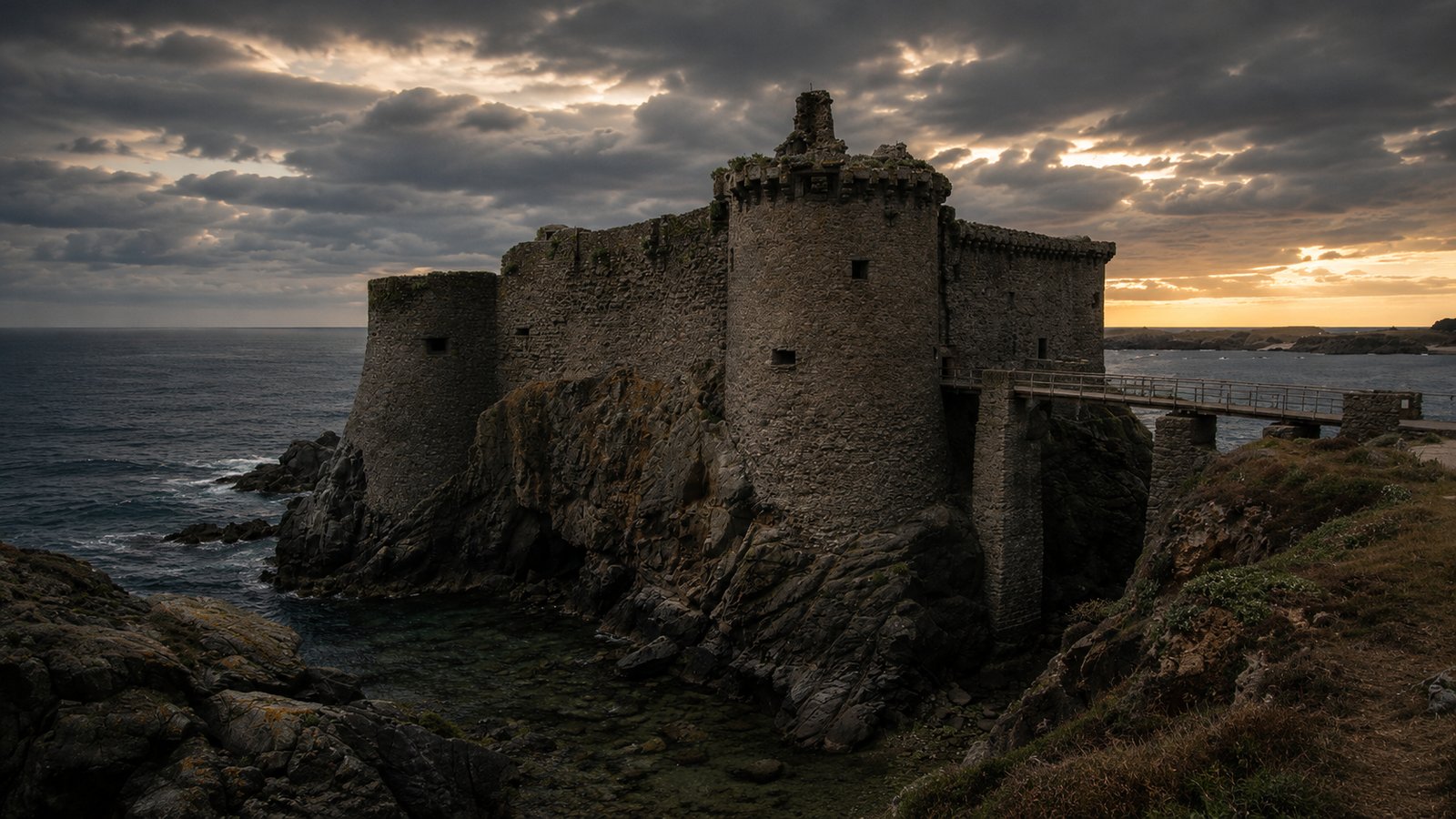
Western Europe · Isolated Landmass
Île d’Yeu
France
Île d’Yeu offers homes, fishing and farmland behind an open-sea barrier. But its drinking water and electricity arrive from mainland France, and its inhabited coastline is far too extensive for a small group to secure.
Overall
4.7 out of 10Defensibility
1 out of 10Isolation
6 out of 10Sustainability
7 out of 10Ranking context
How this base ranks
Global
#57 of 88 · Top 65%
Region · Western Europe
#7 of 9 · Top 78%
Base Type · Isolated Landmass
#10 of 19 · Top 53%
Field assessment
At a glance
Bottom Line
A developed island habitat with real local food pathways, provided the group can keep drinking water available without mistaking mainland separation for control of the island.
Biggest Trade-off
Sea separation limits incoming pressure while putting essential water and power connections beyond the group’s practical control.
Most Likely Failure
Mainland water delivery fails and usable island reserves decline, forcing the group to seek an unverified replacement while maintaining local security.
Score rationale
Why it scores this way
Defensibility · 1/10
The coast separates Yeu from mainland walkers but does not enclose a defensible compound. Once a threat is on the island, roads and dispersed housing leave many local routes towards occupied homes.
Advantages
- Existing buildings offer choices for a small occupied refuge without first constructing accommodation.
Limitations
- Watching the harbour cannot secure the coastline or movements already within the settlement.
Isolation · 6/10
Open sea creates meaningful separation from the Vendée coast. Yeu nevertheless has its own residents and regular transport connections, so arrival cannot be treated as arrival in an empty refuge.
Advantages
- There is no ordinary road approach from mainland population centres to the island.
Limitations
- Any local outbreak begins on the same side of the sea barrier as the survivors.
Sustainability · 7/10
A year-round community provides substantial housing, sanitation and food-preparation capacity. Keeping that habitat occupied depends on water access and continuing production as mainland utilities and deliveries become unreliable.
Advantages
- Farms and fisheries already exist; the group need not invent a food economy from bare ground.
Limitations
- Spare homes and agricultural potential do not replace the mainland-fed drinking-water system.
Survival horizons
How survival changes over time
Put water before territory
First 7 Days
Check potable water at the chosen homes and identify accessible food before claiming a wider area. Observe nearby roads and harbour movements; landing on an inhabited island does not establish local safety.
Positive factors
- Existing accommodation permits early organisation around a limited set of daily journeys.
Risks
- Nominal reservoir capacity can conceal unavailable water or a distribution fault.
Measure use against replacement
First 100 Days
Track water consumption and delivery, then organise food work around usable boats, tools and fields. Balance production trips with watches rather than assuming a smaller population makes island systems effortless to maintain.
Positive factors
- Established short supply chains give practical starting points for local food work.
Risks
- A water interruption can consume attention while routine fishing or cultivation is neglected.
Find a durable water pathway
Long Term
Continued occupation requires safe water renewal alongside food production and repairs. The evidence establishes mainland-fed supply and island storage, not a verified independent replacement; reducing consumption alone cannot close that gap indefinitely.
Positive factors
- Ordinary homes and working land retain value after some powered services decline.
Risks
- Food production may remain possible while lack of dependable potable water makes occupation untenable.
Visual survey
Gallery
Location context
The Lay of the Land
Tactical assessment
Practical Reality
Best Use
Keep daily life compact around verified drinking water and accessible food. Assess journeys between homes, fields and harbour before spreading watches across the island.
Strengths
- Established homes and domestic services offer separate spaces for sleeping, food preparation and storage.
- Active fishing and local agriculture provide existing routes to food replacement beyond shop inventories.
- Open water interrupts ordinary ground approaches from the mainland before they reach island streets.
Key Risk
The water network can remain the limiting system even when housing and food-producing land are abundant. Storage buys a margin only if water is actually present, potable and accessible.
Weaknesses
- Harbour access, a long coastline and distributed homes leave more approaches than twenty people can watch continuously.
- Drinking-water delivery and electricity rely on submarine mainland connections and maintained distribution.
- The July 2026 conservation appeal documents service pressure, without establishing spare capacity or outage endurance.
Reality Check & Constraints
Published reservoir capacity is not a measured stock available to twenty people. Fishing and farming need equipment and labour; they are not an automatic diet inherited with the island.
Assumptions / constraints
- The group remains twenty capable adults; residents are neither assumed absent nor added as fishermen, farmers or utility operators.
- The whole inhabited island remains the Base. A compact occupation plan does not substitute a fort or Port-Joinville for that geography.
- Reservoir levels, accessible provisions, equipment condition and independent potable-water continuity are unverified. No ferry, mainland supply or survival duration is guaranteed.
Decision context
Rivals / Alternatives
Similar rival
Seychelles
Seychelles · Isolated Landmass
Seychelles keeps the same isolated landmass strategy, with only 0.0 points between the overall scores and closely matched defensibility pressure.
Overall 4.7/10
Strongest alternative
Heligoland
Germany · Isolated Landmass
Heligoland scores 6.3 overall versus 4.7, adding a stronger isolation profile while staying relevant as another isolated landmass.
Overall 6.3/10
Wildcard rival
San Felipe Fortress
Colombia · Fortified Structure
San Felipe Fortress changes the strategy: it is built around the fortified structure strategy with a defensibility edge, while Île d’Yeu holds more of the isolation advantage.
Overall 3.7/10