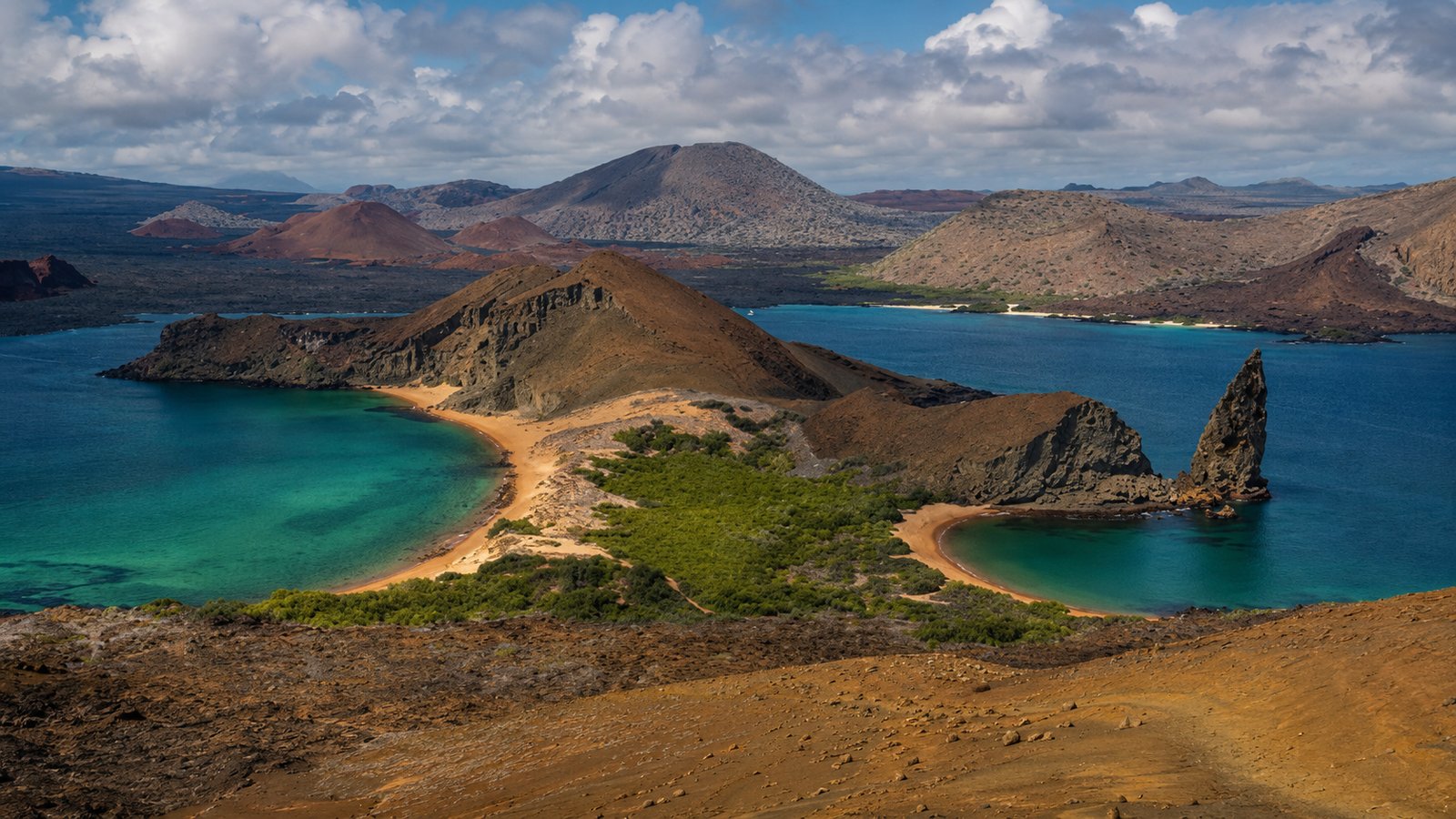
South America · Isolated Landmass
Galápagos Islands
Ecuador
Galápagos offers ocean separation, established settlements and local food production across an inhabited archipelago. The challenge is connecting shelter to safe water and usable supplies as island utilities and transport lose outside support.
Overall
5.3 out of 10Defensibility
1 out of 10Isolation
8 out of 10Sustainability
7 out of 10Ranking context
How this base ranks
Global
#27 of 88 · Top 31%
Region · South America
#2 of 7 · Top 29%
Base Type · Isolated Landmass
#4 of 19 · Top 21%
Field assessment
At a glance
Bottom Line
A remote region with credible places to live and produce food, but a small community must secure practical access to essentials rather than rely on the archipelago’s collective capacity.
Biggest Trade-off
Ocean and inter-island distances slow incoming contact while making it harder to reach resources, spare parts and help that may exist on another island.
Most Likely Failure
Declining fuel, water treatment or transport cuts the group off from safe daily provision, despite houses, farms and infrastructure remaining elsewhere in the archipelago.
Score rationale
Why it scores this way
Defensibility · 1/10
The evaluated Base spans settlements, ports and coastlines across several islands. A group can organise a chosen living area, but cannot turn the archipelago into one guarded enclosure; the surrounding ocean is separation rather than a local perimeter.
Advantages
- Existing buildings offer places to concentrate occupation instead of spreading people across the entire territory.
Limitations
- Control of a household does not secure the roads, landing places and other communities beyond it.
Isolation · 8/10
Around a thousand kilometres of Pacific separate Galápagos from continental Ecuador. That is a major barrier to incoming ground pressure, while resident populations and established transport prevent distance from amounting to complete exclusion.
Advantages
- Water between inhabited islands interrupts continuous local ground movement as well as mainland approach.
Limitations
- Threats may already be present within the island communities on which shelter and services depend.
Sustainability · 7/10
Housing, service infrastructure and agriculture support real habitation. Their distribution matters: safe water differs by island, and useful facilities may depend on powered systems the group cannot independently operate or repair.
Advantages
- Domestic and work spaces already exist, allowing occupation to begin with an established settlement layout.
Limitations
- A functioning island society normally draws on fuel, parts and expertise beyond a small survivor household.
Survival horizons
How survival changes over time
Connect shelter to safe water
First 7 Days
Choose a manageable occupied area after checking access, drinking water and sanitation together. Inventory nearby provisions and examine essential routes before relying on another island’s resources; arrival somewhere remote does not settle the household’s first needs.
Positive factors
- Established homes and service spaces provide an immediate starting point for rest and organisation.
Risks
- Using untreated or inadequately managed water can undermine the refuge before outside contact becomes decisive.
Test what still reaches the household
First 100 Days
Track food and fuel consumption, water reliability and the upkeep needed for essential journeys. Assess which nearby production and services remain usable as normal logistics fade, rather than counting distant facilities as supplies already secured.
Positive factors
- Local agriculture offers a provision pathway to assess alongside whatever stores are actually available.
Risks
- Fuel or equipment problems can interrupt water and movement before the group has a workable replacement.
Sustain provision through dry periods
Long Term
Lasting occupation depends on repeatable food and safe-water provision through variable rainfall, with maintenance the group can actually sustain. Local production is a foundation to verify, not a guarantee that imported fuel, parts and food categories become unnecessary.
Positive factors
- Productive land and natural freshwater in parts of the archipelago offer more than a purely stock-dependent refuge.
Risks
- Drought can weaken food production and water availability together, leaving distant resources unable to meet local needs.
Visual survey
Gallery
Location context
The Lay of the Land
Tactical assessment
Practical Reality
Best Use
Keep daily living, a verified water source and accessible food within a manageable operating area. Treat inter-island movement as a separate capability to verify, without substituting one favoured island or station for the whole Base.
Strengths
- The Pacific interrupts ordinary overland movement from mainland population centres.
- Existing settlements provide housing and service space well beyond a twenty-person household’s immediate footprint.
- Agriculture and food processing provide an evidenced basis for local provision rather than reliance on imported stores alone.
Key Risk
San Cristóbal has natural freshwater, while Santa Cruz and Isabela draw on brackish groundwater. Historical contamination findings mean source type alone cannot establish safe water at the tap or continued treatment.
Weaknesses
- Multiple inhabited islands and shores cannot be held as a continuous defensive position by twenty people.
- Predominantly diesel-based electricity exposes essential services to imported fuel and specialist upkeep.
- Documented drought impacts show that local agriculture is vulnerable alongside the water supply.
Reality Check & Constraints
Galápagos has resident communities and routine transport links. Remoteness does not establish an infection-free arrival, an available vessel or the technical crew needed to run island utilities.
Assumptions / constraints
- The canonical archipelago remains whole; no preferred island, town or research station becomes a replacement Base, and the wider marine reserve is not defended territory.
- Twenty capable adults have ordinary practical skills, without assumed boats, pilots, utility operators or guaranteed mainland resupply.
- Water quality, usable stocks, equipment and routes require local checks; historical monitoring and generation reports do not certify present operation.
Decision context
Rivals / Alternatives
Similar rival
Lakshadweep
India · Isolated Landmass
Lakshadweep keeps the same isolated landmass strategy, with only 0.3 points between the overall scores and closely matched defensibility pressure.
Overall 5/10
Strongest alternative
Amundsen-Scott South Pole Station
Antarctica · Institutional Compound
Amundsen-Scott South Pole Station scores 7.7 overall versus 5.3, adding a stronger defensibility profile while staying relevant as a comparable survival plan.
Overall 7.7/10
Wildcard rival
San Felipe Fortress
Colombia · Fortified Structure
San Felipe Fortress changes the strategy: it is built around the fortified structure strategy with a defensibility edge, while Galápagos Islands holds more of the isolation advantage.
Overall 3.7/10