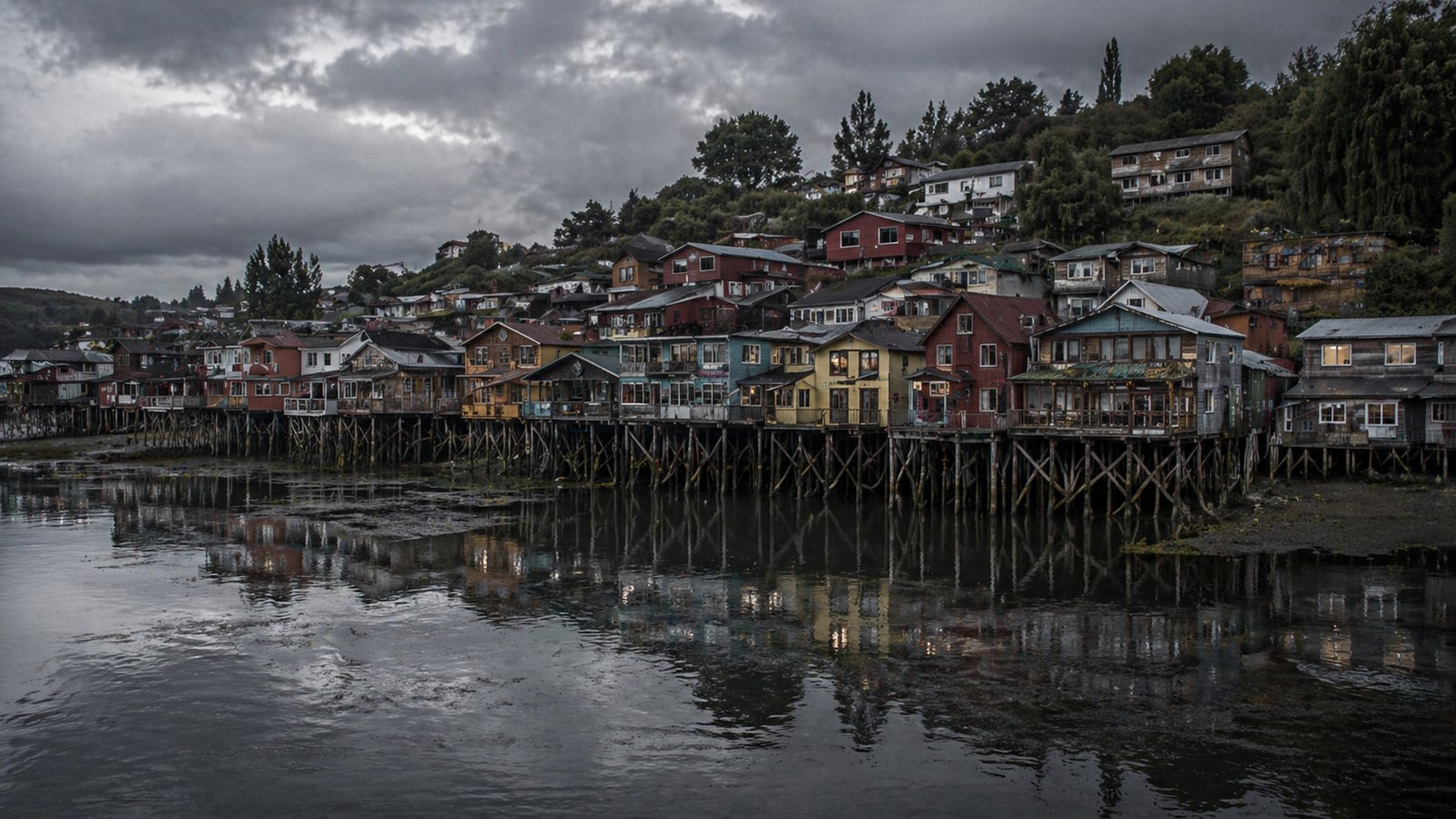
South America · Isolated Landmass
Chiloé Island
Chile
Chiloé combines established settlements, water services, agriculture and fisheries behind a real maritime barrier. Its inhabited island system offers substantial living resources, but twenty survivors cannot secure its towns, roads and coastline as one defended refuge.
Overall
4 out of 10Defensibility
1 out of 10Isolation
3 out of 10Sustainability
8 out of 10Ranking context
How this base ranks
Global
#66 of 88 · Top 75%
Region · South America
#6 of 7 · Top 86%
Base Type · Isolated Landmass
#12 of 19 · Top 63%
Field assessment
At a glance
Bottom Line
A resource-rich inhabited landscape with a weak whole-island defensive boundary. The practical challenge is reaching usable shelter and supplies without mistaking regional abundance for resources the group controls.
Biggest Trade-off
The settlement network that supplies housing, services and food also contains population pressure and many routes between communities. Sea separation helps at the mainland edge while leaving a large internal operating problem.
Most Likely Failure
Utility faults and interrupted transport separate the group from resources that still exist elsewhere on Chiloé. Food-producing land and plentiful buildings cannot compensate if safe water and essential movements become unreliable.
Score rationale
Why it scores this way
Defensibility · 1/10
Many settlements, roads and landing opportunities divide attention across a long coastline. The whole island system supplies no manageable continuous perimeter for twenty people, even where individual buildings offer shelter.
Advantages
- Existing settlement buildings provide physical cover for local occupation.
Limitations
- Protecting a room or street does not control the island’s other communities, approaches or movements between them.
Isolation · 3/10
The Chacao Channel creates meaningful mainland separation, but Chiloé already contains a substantial resident population. Ferry and air connections demonstrate regional accessibility, rather than the remoteness of a sparsely inhabited offshore refuge.
Advantages
- Water interrupts ordinary direct ground movement from the mainland.
Limitations
- Threats can already be present within the settlements; controlling outside arrivals would not remove internal pressure.
Sustainability · 8/10
Year-round communities, managed water and sanitation, and established agricultural and marine-food systems provide a strong basis for habitation. Their utility depends on keeping the relevant local services and production processes usable.
Advantages
- Existing houses and community infrastructure provide far more functional living capacity than a visitor-only site.
Limitations
- National-grid dependence and maintained water systems link daily habitation to technical services that a small group cannot operate island-wide.
Survival horizons
How survival changes over time
Locate usable support
First 7 Days
Verify the condition of occupied buildings, drinking water and accessible supplies before making journeys between communities. Identify immediate local pressure rather than assuming arrival on an island provides a clean start.
Positive factors
- Established settlements offer existing spaces for sleeping, food preparation and daily organisation.
Risks
- The population and connected internal roads leave threats on the same side of the maritime barrier as the group.
Keep resources connected
First 100 Days
As ordinary services become less dependable, compare actual consumption with reliable access to water and food. Maintenance and travel now compete with watches and daily work; resources elsewhere on the island remain useful only if reachable.
Positive factors
- Agriculture and fisheries provide genuine local production pathways beyond consuming imported shop stocks alone.
Risks
- Pumps, treatment, powered equipment and transport may need parts, fuel or expertise that the group cannot replace.
Sustain repeatable production
Long Term
Lasting occupation depends on repeated harvests, usable marine food and safe water with a workload the group can meet. Chiloé has real renewal potential, but the evidence does not establish an autonomous twenty-person system or continuing national services.
Positive factors
- Continuing agricultural traditions and marine production give the island system resources capable of renewal.
Risks
- A productive region can still lose essential connections, equipment and water-service continuity; no guaranteed yield or external replacement supply is credited.
Visual survey
Gallery
Location context
The Lay of the Land
Tactical assessment
Practical Reality
Best Use
Keep daily movements tied to verified shelter, water and usable food pathways within the recorded island system. Limit commitments to what twenty people can operate; no preferred farm, town or fortified compound is substituted for this broad Base.
Strengths
- A mature residential settlement network supplies existing living and communal infrastructure.
- Agriculture and marine-food production give the island system several real food pathways.
- Managed potable-water and sanitation systems establish existing habitat support rather than a bare coastal shelter.
Key Risk
Operating and connecting existing assets is the constraint. The group does not become the workforce for municipal water, electricity, farms and fishing fleets simply because those systems lie within the evaluated geography.
Weaknesses
- The long coastline and multiple communities exceed what twenty people can watch or defend as one position.
- The resident population creates internal pressure that mainland water separation cannot exclude.
- Electricity, water equipment and wider logistics retain technical and external supply dependencies.
Reality Check & Constraints
Chiloé’s documented food sectors and inhabited infrastructure are real strengths. They prove neither available stock quantities nor the group’s access to equipment, skills and working utilities; local production is not automatic household self-sufficiency.
Assumptions / constraints
- The inherited island/archipelago system centred on Isla Grande and associated inhabited communities remains the Base. Castro, Ancud, Quellón, a single farm or church is not promoted into a new preferred Core Base.
- The fixed group has twenty capable adults with ordinary skills. Existing agricultural and fishing activity does not guarantee a specialist crew, accessible vessel, equipment or secure allocation of produce.
- Mainland resources, guaranteed ferry or air service, independent grid generation and assured water continuity are excluded. Horizons describe changing tasks, not promised yields or survival durations.
Decision context
Rivals / Alternatives
Similar rival
Tasmania
Australia · Isolated Landmass
Tasmania keeps the same isolated landmass strategy, with only 0.3 points between the overall scores and closely matched sustainability pressure.
Overall 4.3/10
Strongest alternative
Heligoland
Germany · Isolated Landmass
Heligoland scores 6.3 overall versus 4.0, adding a stronger isolation profile while staying relevant as another isolated landmass.
Overall 6.3/10
Wildcard rival
Fort Jefferson
United States · Fortified Structure
Fort Jefferson changes the strategy: it is built around the fortified structure strategy with a defensibility edge, while Chiloé Island holds more of the sustainability advantage.
Overall 6.7/10