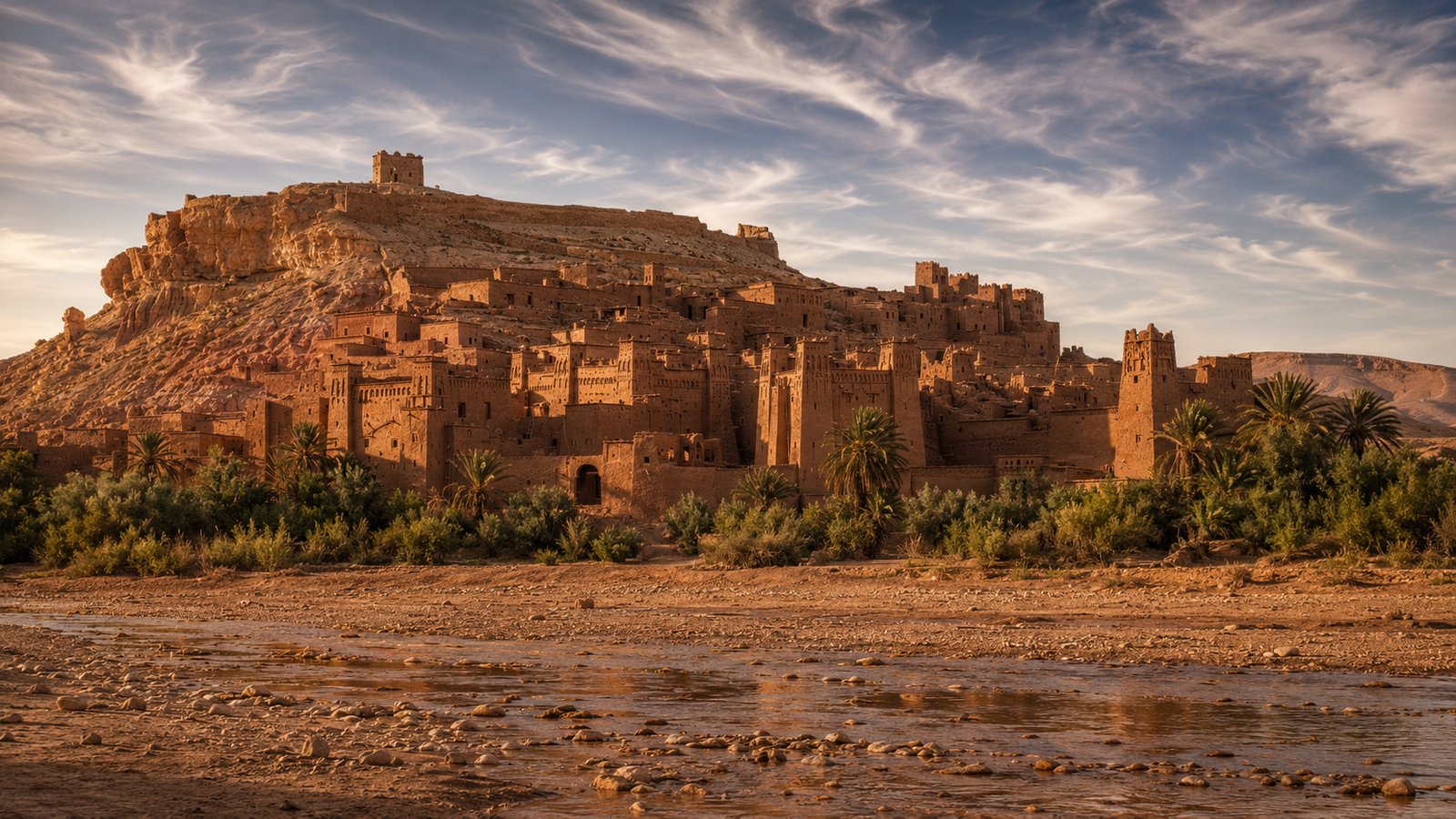
Africa · Remote Settlement
Aït Benhaddou
Morocco
Aït Benhaddou gives twenty survivors a compact historic ksar with walls, corner towers and a controlled main gate. Its weak point is not the entrance but living off what is inside: water infrastructure is documented, yet dependable stores, food renewal and everyday residential services remain uncertain.
Overall
4 out of 10Defensibility
6 out of 10Isolation
3 out of 10Sustainability
3 out of 10Ranking context
How this base ranks
Global
#65 of 88 · Top 74%
Region · Africa
#5 of 11 · Top 45%
Base Type · Remote Settlement
#13 of 16 · Top 81%
Field assessment
At a glance
Bottom Line
Useful as a defensible temporary refuge if occupied buildings and water delivery are verified. Do not mistake historic walls or nearby valley farms for a self-sufficient settlement.
Biggest Trade-off
The walls and gate reduce approach choices, but holding an entire earthen village draws guards and repair effort away from the water, sanitation and food problems that set its endurance ceiling.
Most Likely Failure
The group holds its entry points but cannot keep water reliably available, while clay walls and unoccupied buildings need more repair labour than twenty people can spare.
Score rationale
Why it scores this way
Walls buy time, not an automatic victory · 6/10
The perimeter and towers concentrate entry but are ageing earthen structures.
Analysis
A controlled gate is the strongest starting point. Twenty defenders should secure a small lived-in sector and observe the principal wall approaches; manning every roof and every gap permanently would be expensive. The masonry-like appearance should not be confused with modern fortified construction.
Evidence framing
UNESCO establishes the walls, corner towers, baffle gate and clustered houses; it does not establish a modern protected fighting position.
Advantages
- Gate and towers narrow the most obvious entry routes and improve watch placement.
Limitations
- Earthen walls and an extended perimeter need inspection and repair; a small team cannot treat every rooftop as defended.
Road access cuts both ways · 3/10
The ksar sits apart within its valley but is accessible to neighbouring settlements and visitors.
Analysis
The site is easier to identify and reach than a truly remote refuge. That reduces travel difficulty for the group, but it also means traffic can approach through the same roads and gate. Isolation should not be credited simply because the skyline looks empty in photographs.
Evidence framing
The pre-Saharan valley context and surrounding modern settlement are outside the defended walled core.
Advantages
- A distinct settlement footprint gives a legible local approach to monitor.
Limitations
- Nearby inhabited and visited routes keep the external-contact burden real.
Water and restoration decide endurance · 3/10
Historic dwellings and delivered utilities offer some habitation potential, but service readiness is not proven.
Analysis
The first task is to confirm clean water, storage, wastewater handling, usable interiors and cooking space. Conservation work and partially abandoned buildings make moving into every house unsafe as an assumption. A small group should select the soundest rooms and invest labour in essential services, not cosmetic restoration.
Evidence framing
UNESCO reporting documents water and wastewater infrastructure, while conservation decisions record restoration needs; neither guarantees present availability or survival-scale operating stock.
Advantages
- Existing houses plus documented water/wastewater works are more useful than an empty fort.
Limitations
- No proven independent water stock, agricultural renewal or reliable energy for an extended twenty-person occupation.
Survival horizons
How survival changes over time
First seven days — inspect, narrow, secure
First 7 Days
Concentrate the group, establish a daylight watch on the gate and walls, and verify a working potable-water point before settling in.
Positive factors
- High walls and a distinct gate permit a tight initial perimeter plan.
Risks
- Unknown building condition and unverified functioning taps may make apparently available shelter unusable.
First hundred days — service reliability
First 100 Days
Shift effort from fortifying the entire village to maintaining selected houses, wastewater handling and controlled food and water use.
Positive factors
- Documented community buildings and utility improvements could support concentrated occupation if inspected and operational.
Risks
- Earthen maintenance burden, unproven utility throughput and uncertain food supply will accumulate.
Long term — water and renewal limit the plan
Long Term
The ksar is not a proven closed resource system. Remaining here requires verified reliable water, food renewal and ongoing repairs that are not presently established.
Positive factors
- The walls remain useful for keeping a modest defended footprint.
Risks
- Failure of independent water, food or maintenance capacity can force departure despite an intact gate.
Visual survey
Gallery
Location context
The Lay of the Land
Tactical assessment
Practical Reality
Best Use
Start with a small, inspected cluster of habitable houses near the gate; post a watch on the main approaches and verify taps, storage and wastewater function before spreading the group through the ksar.
Strengths
- A high perimeter with corner towers and one notable defensive gate channels primary entry routes.
- Clustered historic houses give room to concentrate twenty people instead of occupying the whole site.
- A potable-water supply and wastewater-treatment programme is documented; that is an actual asset worth inspecting, not proof of independent service.
Key Risk
Delivered potable-water and wastewater infrastructure has been documented, not its present flow, protected storage or ability to serve twenty indefinitely. Once those systems fail, the defensive geometry buys little endurance.
Weaknesses
- Existing access from an inhabited valley means the ksar is not geographically isolated from outside movement.
- Earth walls and partly abandoned dwellings demand careful inspection, dry-weather maintenance and specialist repairs.
- Protected storage, renewable food and energy continuity inside the ksar are not established.
Reality Check & Constraints
UNESCO records active conservation and restoration needs. The defended Base is the walled ksar; the Ounila valley fields, modern settlement, tourism services and unverified external supplies are outside its credited capabilities.
Assumptions / constraints
- Twenty capable adults occupy only the defined walled core; neighbouring cultivation, infrastructure and delivered supplies are not automatically controlled.
Decision context
Rivals / Alternatives
Similar rival
Kolmanskop
Namibia · Remote Settlement
Kolmanskop keeps the same remote settlement strategy, with only 0.7 points between the overall scores and closely matched isolation pressure.
Overall 3.3/10
Strongest alternative
Isle of Eigg Village
United Kingdom · Remote Settlement
Isle of Eigg Village scores 6.3 overall versus 4.0, adding a stronger isolation profile while staying relevant as another remote settlement.
Overall 6.3/10
Wildcard rival
Amundsen-Scott South Pole Station
Antarctica · Institutional Compound
Amundsen-Scott South Pole Station changes the strategy: it is built around the institutional compound strategy with a isolation edge, while Aït Benhaddou holds more of the defensibility advantage.
Overall 7.7/10