North America · Fortified Structure
Fort Jefferson
United States
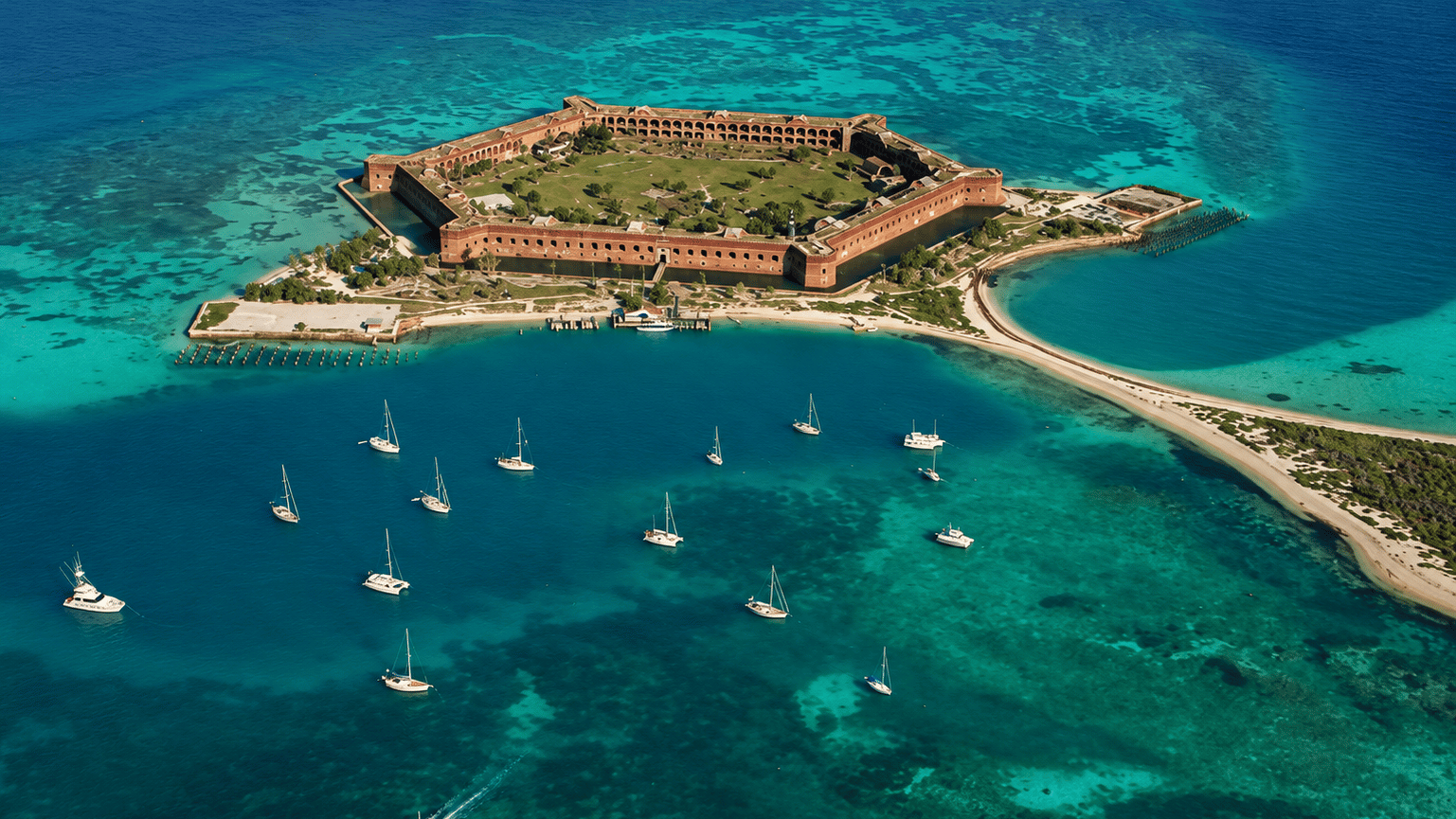
Fort Jefferson offers moat, masonry and open-water separation far from Key West. Twenty survivors can find substantial shelter, but Garden Key’s primitive facilities do not provide the food, drinking water or fuel needed to stay.
Overall
6.7 out of 10Defensibility
8 out of 10Isolation
9 out of 10Sustainability
3 out of 10Ranking context
How this base ranks
Global
#3 of 88 · Top 3%
Region · North America
#1 of 9 · Top 11%
Base Type · Fortified Structure
#2 of 18 · Top 11%
Field assessment
At a glance
Bottom Line
A strong refuge only if the group can account for its water and food; reaching protected ground does not establish a viable residence.
Biggest Trade-off
Long water separation limits ordinary arrival pressure while making every missing essential harder to replace.
Most Likely Failure
The group consumes its available drinking water or food and must abandon a still-protective fort because no dependable replenishment pathway has been established.
Score rationale
Why it scores this way
Defensibility · 8/10
The moat, thick masonry and internal casemates layer protection around occupied space. Select sound areas rather than assuming the fort’s entire historic envelope remains uniformly intact.
Advantages
- Existing casemates offer protected positions and places to separate people within the fort.
Limitations
- Documented deterioration limits reliance on damaged areas; twenty survivors cannot assume they can undertake specialist masonry stabilization.
Isolation · 9/10
The long open-water crossing and absence of a road remove ordinary land access from Key West. They also separate the group from the services on which present-day visits depend.
Advantages
- No continuous land route brings regional ground movement to Garden Key.
Limitations
- A vessel or aircraft can still arrive, and the group cannot count on either remaining available for its own departure.
Sustainability · 3/10
The fort supplies shelter, while Garden Key’s facilities support primitive visits rather than independent residence. Daily water, food and sanitation must be assessed separately from the amount of available space.
Advantages
- Passive masonry shelter does not require a generator simply to remain standing.
Limitations
- Present visitor provision does not establish renewable drinking water, food or fuel for prolonged occupation.
Survival horizons
How survival changes over time
Account for every essential
First 7 Days
Choose sound shelter, check access and inventory the water and food actually brought or found. Set the decision to remain against those verified resources.
Positive factors
- Layered fortifications provide a substantial existing refuge while the group assesses daily needs.
Risks
- An arrival plan that assumes supplies on the island can fail before ordinary defensive pressure becomes decisive.
Watch consumption and condition
First 100 Days
Track the usable inventory, sanitation burden and condition of occupied masonry. Reassess continued residence before dwindling essentials force an urgent crossing.
Positive factors
- A small occupied area can retain shelter value without operating a large utility plant.
Risks
- No recorded stock quantity establishes that the group can reach this horizon, even if the walls remain protective.
Renewal remains unproven
Long Term
Long-term residence needs repeatable potable water and food, alongside upkeep of occupied structures. The existing evidence does not establish those renewal systems.
Positive factors
- Water separation and passive fort geometry continue to help control external contact.
Risks
- Import dependence and specialist coastal maintenance can outlast the group’s capacity to supply or repair the site.
Visual survey
Gallery
Location context
The Lay of the Land
Tactical assessment
Practical Reality
Best Use
Select sound sheltered space within the fort and make a verified water-and-food inventory the condition for remaining, before committing labour to wider occupation.
Strengths
- Masonry walls, moat and casemates provide existing layers of protection without powered defensive machinery.
- Roughly seventy miles of open water separates Garden Key from Key West, with no road or bridge connection.
- The fort’s enclosed footprint leaves twenty people room for sleeping, storage and separation within selected sound areas.
Key Risk
Water and food must come from resources actually available to the group; neither historic storage nor the surrounding sea proves a usable supply.
Weaknesses
- Current visitor guidance requires imported drinking water and food; protected space does not meet either daily need.
- Garden Key’s primitive sanitation and absence of normal public utility services limit ready-made residential comfort.
- Salt-related masonry deterioration requires selective use and specialist stabilization beyond ordinary housekeeping.
Reality Check & Constraints
The model is twenty capable adults using the surviving fort and Garden Key. It does not inherit a historic garrison, stocked cisterns, vessels or continuing ferry service.
Assumptions / constraints
- Twenty capable adults have no guaranteed boat, ferry, seaplane, mainland supply chain or historic military stocks.
- Any carried supplies must be inventoried; potable rainwater capture, desalination, fishing and food production are not assumed available capabilities.
Decision context
Rivals / Alternatives
Similar rival
Alcatraz Island
United States · Fortified Structure
Alcatraz Island keeps the same fortified structure strategy, with only 0.7 points between the overall scores and closely matched sustainability pressure.
Overall 6/10
Strongest alternative
Amundsen-Scott South Pole Station
Antarctica · Institutional Compound
Amundsen-Scott South Pole Station scores 7.7 overall versus 6.7, adding a stronger sustainability profile while staying relevant as a comparable survival plan.
Overall 7.7/10
Wildcard rival
Okinawa
Japan · Isolated Landmass
Okinawa changes the strategy: it is built around the isolated landmass strategy with a sustainability edge, while Fort Jefferson holds more of the isolation advantage.
Overall 3.7/10