North America · Industrial Site
Hutchinson Salt Storage Caverns
USA
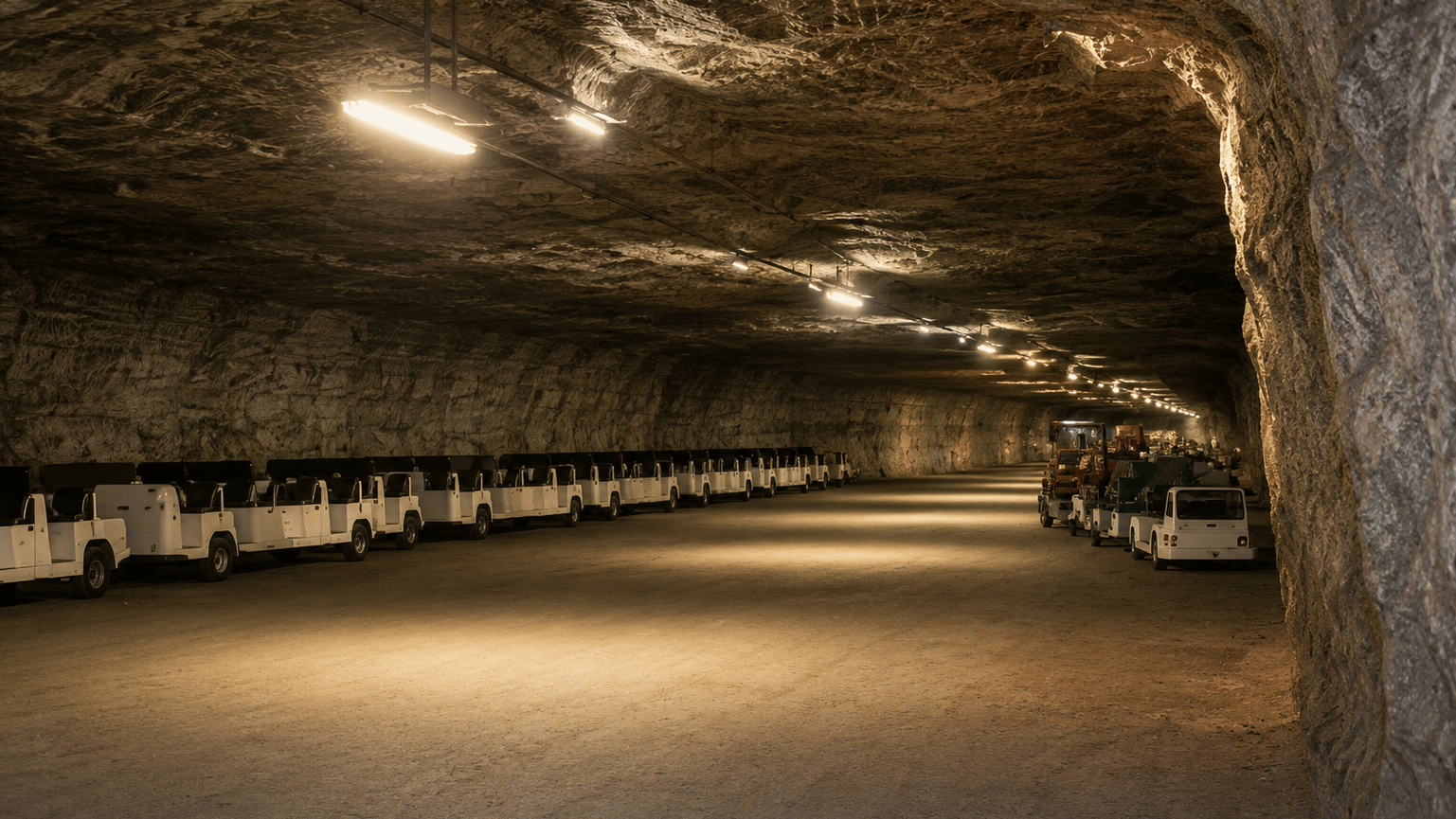
Hutchinson’s connected salt mine offers deep shelter, stable temperatures and visitor facilities beneath the city. Shaft access channels arrival, but keeping people supplied and able to leave depends on systems that ordinary survivors cannot assume they can operate.
Overall
3.7 out of 10Defensibility
5 out of 10Isolation
2 out of 10Sustainability
4 out of 10Ranking context
How this base ranks
Global
#74 of 88 · Top 84%
Region · North America
#8 of 9 · Top 89%
Base Type · Industrial Site
#1 of 2 · Top 50%
Field assessment
At a glance
Bottom Line
A strong physical refuge with a supplied visitor habitat, conditional on verified water, safe access and essential mine systems; underground space alone cannot make it a durable home.
Biggest Trade-off
The vertical separation that restricts approach also makes routine supply and departure dependent on functioning access infrastructure.
Most Likely Failure
Surface provisioning or powered access becomes unreliable, leaving the group with diminishing drinking supplies and a much harder journey out.
Score rationale
Why it scores this way
Defensibility · 5/10
Overburden and vertical access create a useful barrier between the surface and occupied rooms. The connected industrial network is too extensive and insufficiently mapped in public evidence to claim a fully controlled underground perimeter.
Advantages
- Ordinary ground movement cannot reach the visitor area directly across the surrounding landscape.
Limitations
- Securing the known visitor approach does not prove that every shaft or operational connection is controlled.
Isolation · 2/10
The mine lies beneath Hutchinson, close to the city’s population and access network. Depth changes how threats approach the refuge; it does not provide regional remoteness.
Advantages
- Underground separation interrupts direct contact from people moving through the surface surroundings.
Limitations
- Journeys to the surface return the group to the same urban setting from which it took shelter.
Sustainability · 4/10
Stable temperatures, visitor facilities and demonstrated overnight use make the mine more habitable than an undeveloped cave. Long occupation still needs dependable drinking water, sanitation and safe access after normal surface support declines.
Advantages
- Large established rooms allow sleeping, storage and communal activity to be separated without crowding the reference group.
Limitations
- A catering area and a scheduled overnight programme prove supplied use, not a kitchen, water source or waste system the group can operate indefinitely.
Survival horizons
How survival changes over time
Verify the way in and out
First 7 Days
Before settling underground, check exit arrangements, essential operating conditions and accessible water. Establish a small occupied area and surface watch responsibilities; the visitor route does not justify treating all connected workings as safe living space.
Positive factors
- Existing visitor rooms provide an immediate sheltered space with a demonstrated history of human occupation.
Risks
- Descending without understanding access dependence can leave a secure-looking refuge difficult to exit when power fails.
Account for every supplied essential
First 100 Days
As provisions diminish, compare actual water and food use with reliable access to replacements. Assess routine equipment care and sanitation demands rather than taking the active mine’s normal service level for granted.
Positive factors
- Stable temperatures and spacious rooms continue to reduce basic shelter and crowding problems.
Risks
- Repeated surface provisioning creates exposure and consumes labour while faults in access equipment can cut into the remaining supply margin.
Shelter cannot renew supplies
Long Term
The underground environment persists, but no independent food, potable-water or survival-energy pathway is established. Continued habitation remains conditional on renewing essential supplies and maintaining safe access; neither follows from the volume of mined space.
Positive factors
- Passive overburden and the stable environment retain shelter value without extending the mine or constructing new living space.
Risks
- Shrinking reserves and machinery the group cannot repair can make leaving necessary just as safe movement to the surface becomes less dependable.
Visual survey
Gallery
Location context
The Lay of the Land
Tactical assessment
Practical Reality
Best Use
Use an inspected visitor area as a compact refuge only after checking drinking water, sanitation and safe exit arrangements. Keep access to the controlled surface compound under observation rather than exploring the wider mine.
Strengths
- Deep overburden and hoist-based visitor access restrict ordinary direct approaches to occupied underground rooms.
- A stable underground environment reduces exposure to surface weather without requiring the group to construct shelter.
- Established visitor, overnight and event spaces demonstrate room for sleeping, gathering and organising supplies.
Key Risk
A small group must divide attention between underground needs and surface access. Hoists and other essential mine infrastructure demand knowledge that the reference community is not guaranteed to possess.
Weaknesses
- Safe access and current operation rely on industrial equipment and surface infrastructure that require maintenance.
- Food and drink brought underground for visitors do not establish a renewable supply or independent potable-water system.
- The extensive connected passages are not fully described by the public visitor route; unverified connections prevent assuming the museum hoist is the only approach.
Reality Check & Constraints
Overnight visits and catered events demonstrate human use, not independent habitation. The public evidence does not establish every access route, a protected water reserve or a fallback when essential mine systems stop.
Assumptions / constraints
- The twenty-person group is not assumed to include hoist operators, mine engineers or a rescue team. Working machinery and safe air conditions require verification.
- The connected working mine, integrated visitor/storage areas and direct access compound remain the Base. Separate regional solution caverns, city supplies and future freight movements are excluded.
- Accessible food and water quantities, backup power, emergency egress and operational condition remain unverified. No resupply or guaranteed underground survival duration is assumed.
Decision context
Rivals / Alternatives
Similar rival
Kimberley Big Hole & Mining Complex
South Africa · Industrial Site
Kimberley Big Hole & Mining Complex keeps the same industrial site strategy, with only 1.0 points between the overall scores and closely matched sustainability pressure.
Overall 2.7/10
Strongest alternative
Fort Jefferson
United States · Fortified Structure
Fort Jefferson scores 6.7 overall versus 3.7, adding a stronger isolation profile while staying relevant as a North America option.
Overall 6.7/10
Wildcard rival
Amundsen-Scott South Pole Station
Antarctica · Institutional Compound
Amundsen-Scott South Pole Station changes the strategy: it is built around the institutional compound strategy with a isolation edge, while Hutchinson Salt Storage Caverns holds more of the defensibility advantage.
Overall 7.7/10