UK & Ireland · Landmark Structure
Fastnet Lighthouse
Ireland
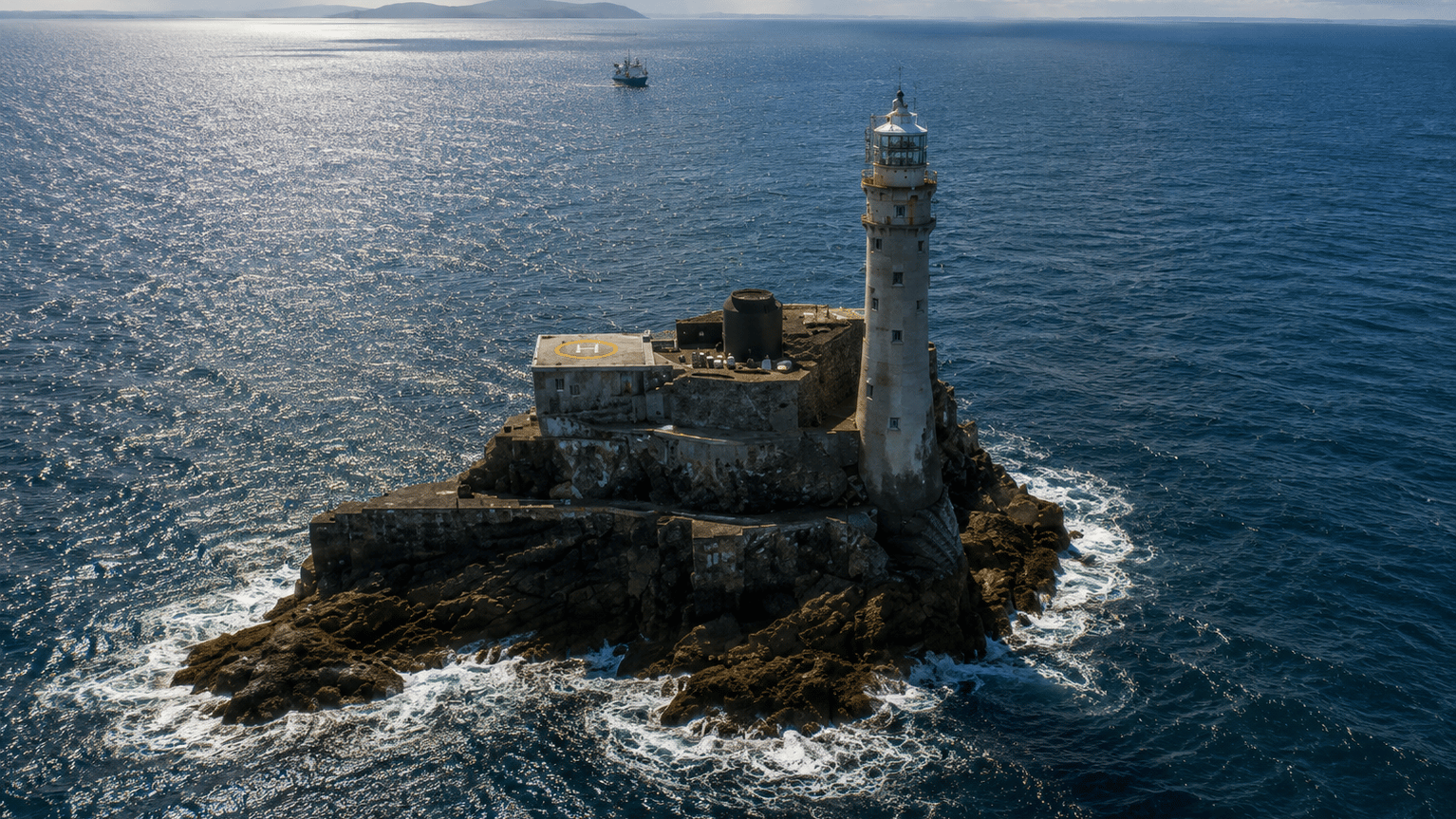
Fastnet places a granite tower beyond an already offshore island, with retained bedrooms and welfare space. Twenty survivors would gain exceptional separation at the cost of cramped occupation and dependence on difficult sea or air access.
Overall
6.3 out of 10Defensibility
7 out of 10Isolation
9 out of 10Sustainability
3 out of 10Ranking context
How this base ranks
Global
#5 of 88 · Top 6%
Region · UK & Ireland
#2 of 11 · Top 18%
Base Type · Landmark Structure
#1 of 3 · Top 33%
Field assessment
At a glance
Bottom Line
A protected offshore refuge with genuine accommodation, but too little functional space and too much external dependence to treat as a self-sufficient home for twenty.
Biggest Trade-off
The water that keeps population pressure distant also separates the group from replacement essentials and any practical way out.
Most Likely Failure
Usable water, food or fuel becomes inadequate while rough conditions prevent a safe departure or delivery, leaving the group sheltered but unable to meet daily needs.
Score rationale
Why it scores this way
Defensibility · 7/10
The massive granite shell and restricted entry give the occupied tower strong passive protection. A lighthouse still has little internal depth: a problem at the entrance or circulation route affects much of the same small building.
Advantages
- A compact structure lets a small watch focus on a limited set of access points.
Limitations
- There is no substantial separate compound to fall back into if the tower becomes unsafe.
Isolation · 9/10
Fastnet lies several kilometres beyond Cape Clear, with no road or bridge carrying ordinary land movement onto the rock. This creates distance from population sources, separate from the strength of the tower itself.
Advantages
- An outbreak on the Cork mainland has no continuous ground route to the lighthouse.
Limitations
- Maintenance access demonstrates that the rock is reachable; separation is substantial rather than absolute.
Sustainability · 3/10
Retained bedrooms, bathroom and welfare facilities make occupation credible. Fitting twenty people into those spaces while preserving rest, sanitation and movement is a much harder task than accommodating a supported maintenance team.
Advantages
- Shelter and basic domestic spaces already exist, avoiding an immediate need to create them on bare rock.
Limitations
- A water tank and diesel equipment do not establish safe drinking water, reliable operation or continuing fuel supply.
Survival horizons
How survival changes over time
Check the refuge before committing
First 7 Days
Inspect the landing, internal access and usable rooms. Verify drinking water and inventory actual provisions before allocating sleeping and hygiene routines; reaching the rock is not proof that twenty people can remain there safely.
Positive factors
- The existing domestic layout offers somewhere to organise essential indoor tasks immediately.
Risks
- Crowding stores or sleeping places into circulation space can compromise the same routes used for work and emergency movement.
Measure consumption and deterioration
First 100 Days
Track water, food and fuel against what is actually usable, and distinguish ordinary upkeep from specialist faults. Access conditions matter increasingly as the margin in stores shrinks; the building may remain sound while daily provision becomes precarious.
Positive factors
- The passive granite structure can retain shelter value without keeping the navigational equipment operational.
Risks
- Waiting for an essential system to fail may leave too little margin to organise safe outside movement.
Resolve renewal or departure
Long Term
Continued occupation needs repeatable safe-water and food provision, plus fuel or workable alternatives for essential services. The evidence establishes supported stays, not an independent replacement for them; any continuation must rest on verified arrangements rather than tower durability.
Positive factors
- Open-water separation continues to reduce incoming pressure while the group assesses its remaining options.
Risks
- An intact refuge can become a trap if diminishing essentials and unavailable transport leave no viable next step.
Visual survey
Gallery
Location context
The Lay of the Land
Tactical assessment
Practical Reality
Best Use
Use the tower as a refuge only with verified water, provisions and an access plan. Organise sleeping, storage and hygiene around the narrow internal circulation before committing the whole group to occupation.
Strengths
- Dovetailed granite provides protective mass that does not depend on powered security.
- The tiny rock and exposed landing routes concentrate the approaches that need watching.
- Bedrooms, bathroom and welfare space provide an established starting layout for occupation.
Key Risk
A retained tank and generators can look like independence before anyone checks the water, fuel, equipment condition or replenishment pathway.
Weaknesses
- Sleeping, hygiene and stores compete for limited space within a single narrow tower.
- Normal maintenance relies on mechanical, electrical and electronic specialists reaching an exposed station.
- Neither durable food provision nor a verified potable-water replacement pathway is established.
Reality Check & Constraints
Irish Lights teams can stay for weeks during supported works. That establishes real habitation, not a guaranteed duration for twenty survivors without the vessel, helicopter and technical team that normally sustain those visits.
Assumptions / constraints
- The tower, integral rock-level spaces and physical access points are the Base; Cape Clear, vessels and helicopters are external.
- Twenty capable adults bring ordinary practical skills, without an assumed Irish Lights crew, working boat or aircraft.
- Water quality and volume, usable provisions and equipment condition require inspection; the horizon headings promise no survival duration.
Decision context
Rivals / Alternatives
Similar rival
Fort Jefferson
United States · Fortified Structure
Fort Jefferson keeps a close survival profile, with only 0.3 points between the overall scores and closely matched defensibility pressure.
Overall 6.7/10
Strongest alternative
Amundsen-Scott South Pole Station
Antarctica · Institutional Compound
Amundsen-Scott South Pole Station scores 7.7 overall versus 6.3, adding a stronger sustainability profile while staying relevant as a comparable survival plan.
Overall 7.7/10
Wildcard rival
Okinawa
Japan · Isolated Landmass
Okinawa changes the strategy: it is built around the isolated landmass strategy with a sustainability edge, while Fastnet Lighthouse holds more of the isolation advantage.
Overall 3.7/10