South Asia · Elevated Stronghold
Kumbhalgarh Fort
India
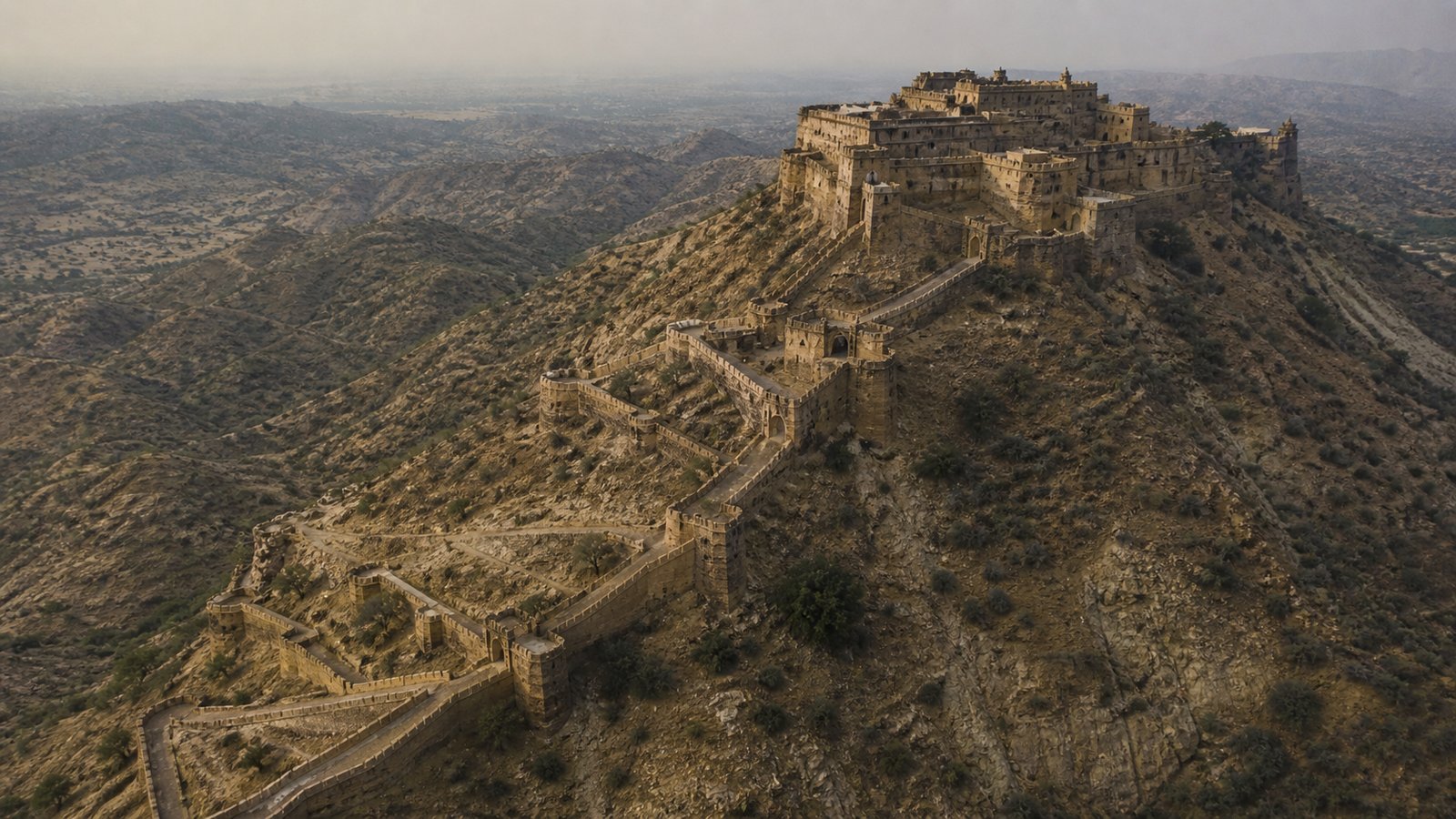
Kumbhalgarh Fort offers massive walls, elevated views and abundant stone shelter in the Aravalli hills. Its scale is also its weakness: a small community cannot watch the whole perimeter, and dependable drinking water remains unproven.
Overall
5 out of 10Defensibility
6 out of 10Isolation
5 out of 10Sustainability
4 out of 10Ranking context
How this base ranks
Global
#36 of 88 · Top 41%
Region · South Asia
#3 of 7 · Top 43%
Base Type · Elevated Stronghold
#3 of 13 · Top 23%
Field assessment
At a glance
Bottom Line
A strong place to resist local pressure, provided occupation stays manageable and a verified water routine supports it. The surviving fort is more convincing as protection than as a self-sufficient home.
Biggest Trade-off
The huge enclosure offers room to separate activities, but dispersing people across it would consume the watches and labour needed for daily provision.
Most Likely Failure
Insufficient safe drinking water forces repeated journeys beyond the occupied refuge, drawing people away from watches and eroding the value of the walls.
Score rationale
Why it scores this way
Defensibility · 6/10
Walls, gates and steep terrain create substantial resistance to local contact. Their passive strength does not remove the manpower needed to notice breaches across an enormous enclosure.
Advantages
- Bastions and internal stone structures offer protected positions beyond an ordinary open settlement.
Limitations
- A strong gate is useful only if pressure elsewhere on the long boundary is detected in time.
Isolation · 5/10
The wilderness hill setting separates Kumbhalgarh from major urban density. Established road access still connects it to nearby settlements and visitor traffic; elevation alone is not remoteness.
Advantages
- Regional pressure must travel through the hill landscape before reaching the fort.
Limitations
- The approach road remains a normal route to the site, even when its final entry is defensible.
Sustainability · 4/10
Substantial historic buildings give a small group ample covered space. Turning that space into dependable daily habitation depends on hygiene, potable water and serviceable rooms, rather than the former royal or military use.
Advantages
- Existing stone shelter can support an occupied refuge without new construction.
Limitations
- A heritage compound has no demonstrated modern residential service capacity simply because a large community once lived there.
Survival horizons
How survival changes over time
Choose shelter, prove water
First 7 Days
Inspect a compact set of rooms, formal access routes and the available water pathway before spreading out. Early effort should establish safe daily living alongside watches.
Positive factors
- The existing enclosure and elevated outlook provide a useful starting framework for local observation.
Risks
- Treating the entire fort as secured would hide gaps in coverage and overcommit the group.
Keep daily work contained
First 100 Days
As provisions are consumed, measure drinking-water reliability and the labour spent collecting it. Concentrated occupation reduces routine travel, while room condition and waste handling need continued attention.
Positive factors
- Much of the protective masonry retains value without a powered defensive system.
Risks
- Unverified sanitation and food replacement can undermine residence while the walls remain effective.
Water works must sustain life
Long Term
Long residence requires repeatable safe water and food renewal within the assessed resource position. Historic collection structures deserve investigation, but neither their yield nor an independent food system is established for the group.
Positive factors
- Durable stone fabric preserves some shelter and protection as modern services become unreliable.
Risks
- A small workforce cannot substitute indefinitely for conservation across the whole property while also resolving essential supplies.
Visual survey
Gallery
Location context
The Lay of the Land
Tactical assessment
Practical Reality
Best Use
Concentrate living and stores near inspected shelter and verified water access. Use the fortifications selectively rather than attempting continuous control of every wall and internal building.
Strengths
- Hilltop views help identify movement before it reaches formal entries.
- Extensive internal buildings allow shelter, storage and work to be separated.
- Existing water-harvesting fabric provides a resource pathway to inspect rather than invent from scratch.
Key Risk
Water-harvesting structures must deliver water that can actually be collected, treated and protected; historic siege endurance does not establish that chain today.
Weaknesses
- The full 268-hectare property exceeds what twenty people can actively watch and defend.
- Modern sleeping and sanitation support is not established merely by the quantity of historic rooms.
- Food renewal and survival-energy continuity within the walls remain unverified.
Reality Check & Constraints
Palaces, temples and water works are genuine assets. Their presence does not establish current food stocks, potable reserves or working residential sanitation inside the fort.
Assumptions / constraints
- The Base remains the UNESCO Kumbhalgarh property; nearby villages, hotels and other Rajasthan forts are excluded.
- No current reservoir contents, treatment performance or stored provisions are assumed.
- Twenty capable adults can organise a compact occupation, but do not inherit a garrison or conservation workforce.
Decision context
Rivals / Alternatives
Similar rival
Tiger’s Nest Monastery
Bhutan · Elevated Stronghold
Tiger’s Nest Monastery keeps the same elevated stronghold strategy, with only 0.3 points between the overall scores and closely matched sustainability pressure.
Overall 4.7/10
Strongest alternative
Amundsen-Scott South Pole Station
Antarctica · Institutional Compound
Amundsen-Scott South Pole Station scores 7.7 overall versus 5.0, adding a stronger sustainability profile while staying relevant as a comparable survival plan.
Overall 7.7/10
Wildcard rival
Okinawa
Japan · Isolated Landmass
Okinawa changes the strategy: it is built around the isolated landmass strategy with a sustainability edge, while Kumbhalgarh Fort holds more of the defensibility advantage.
Overall 3.7/10