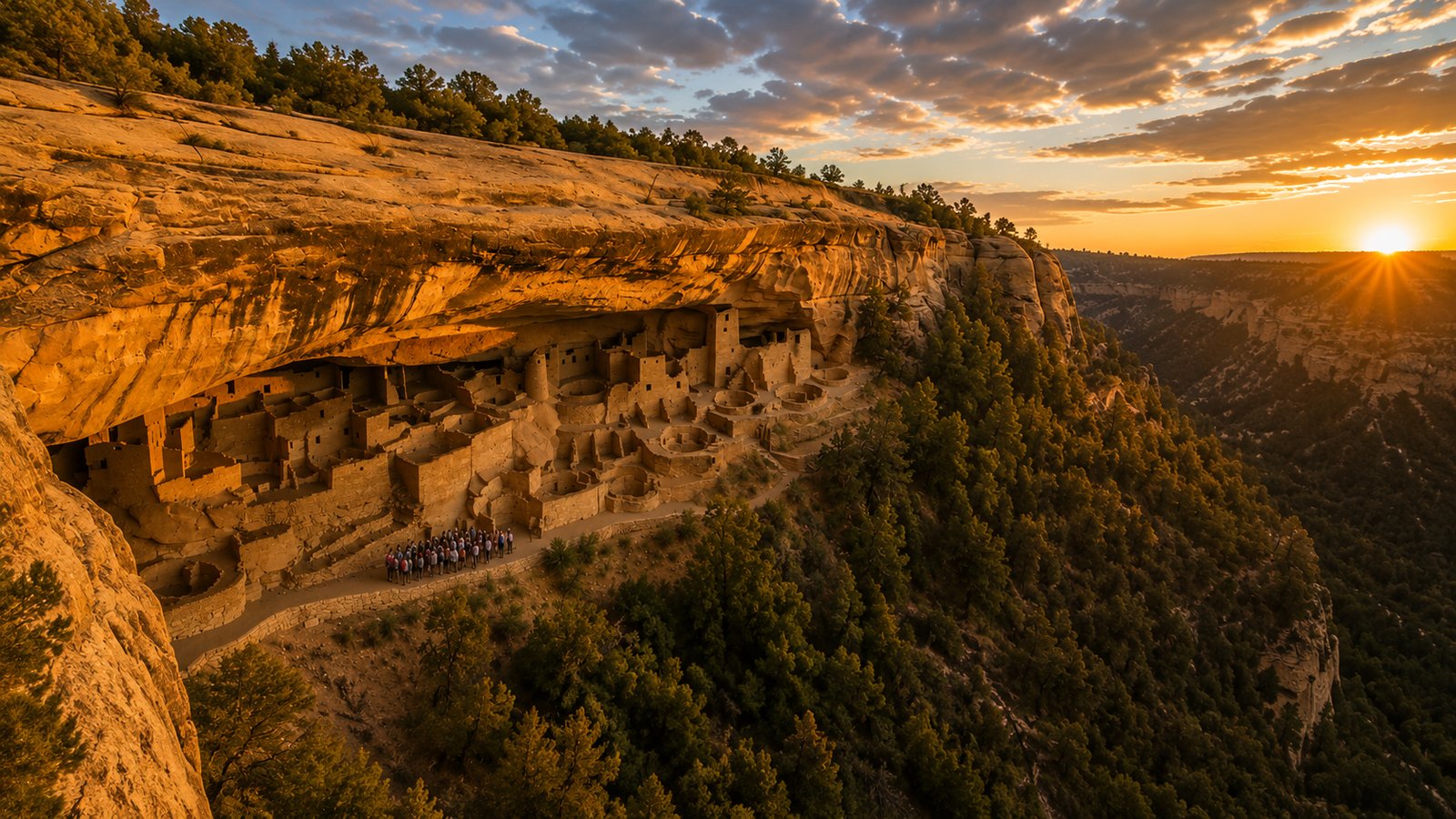
North America · Elevated Stronghold
Mesa Verde
United States
Mesa Verde offers a developed park's lodging, campground and water facilities across a rugged mesa landscape. Those services are more useful for daily life than the cliff dwellings' reputation, but their wide separation prevents a small community from treating the park as one defended enclosure.
Overall
3.7 out of 10Defensibility
1 out of 10Isolation
4 out of 10Sustainability
6 out of 10Ranking context
How this base ranks
Global
#75 of 88 · Top 85%
Region · North America
#9 of 9 · Top 100%
Base Type · Elevated Stronghold
#11 of 13 · Top 85%
Field assessment
At a glance
Bottom Line
A useful range of living facilities with little collective perimeter protection. Viability depends on keeping an occupied area close to working water and sanitation while recognising that most of the park remains beyond continuous control.
Biggest Trade-off
The park's size gives choices of accommodation and services, but journeys between them consume time and expose people. Spare capacity across the landscape is not the same as support concentrated around a secure home.
Most Likely Failure
Service loss spreads the group across increasingly long water, supply and maintenance trips. The wide road network makes that fragmented occupation harder to protect, even where individual buildings remain usable.
Score rationale
Why it scores this way
Defensibility · 1/10
Some cliff dwellings have difficult local approaches, but the park contains dispersed buildings, roads and open visitor areas. Twenty people cannot turn those separate positions into one controlled perimeter.
Advantages
- Selected terrain and buildings offer local positions to inspect and secure.
Limitations
- A defensible room or alcove does not protect journeys across the park.
Isolation · 4/10
The elevated landscape and winding access provide regional separation. Developed visitor connections still bring routes into the park, so distance reduces routine contact without making arrival implausible.
Advantages
- Rugged access slows straightforward movement from surrounding communities.
Limitations
- A road journey remains an established connection rather than an open-water barrier.
Sustainability · 6/10
Lodging, camping, toilets, showers and food-service spaces make this more habitable than an archaeological refuge alone. Their seasonal operation and geographic spread require choosing services that can be kept useful together.
Advantages
- Existing domestic facilities reduce the initial burden of creating sleeping and washing arrangements.
Limitations
- Abundant pitches and rooms do not prove year-round water, warmth or utility continuity.
Survival horizons
How survival changes over time
Find services that work together
First 7 Days
Confirm which accommodation, water points and toilets are usable in the current season. Inventory supplies and map necessary daily journeys before choosing the occupied footprint within the wider park.
Positive factors
- Developed facilities offer shelter and hygiene without first adapting fragile ruins.
Risks
- A dramatic cliff position may be far from the services needed for daily residence.
Distance becomes a daily cost
First 100 Days
Track food use, water reliability and the work of keeping occupied services usable. Review seasonal closures and road condition; reduce unnecessary movement rather than attempting to maintain every developed area.
Positive factors
- Several facility types provide alternatives if one living arrangement proves unsuitable.
Risks
- Repeated supply journeys can fragment a small workforce before shelter space runs short.
Capacity needs renewable support
Long Term
Continued residence needs reliable potable-water provision, food replacement and habitable facilities through changing seasons. Large park acreage and ancient settlement history do not establish a working production system for the present group.
Positive factors
- The existing developed footprint remains a useful foundation where basic services can be maintained.
Risks
- Utility failure can leave plentiful space without a sustainable way to inhabit it.
Visual survey
Gallery
Location context
The Lay of the Land
Tactical assessment
Practical Reality
Best Use
Base domestic routines around inspected developed facilities, with explicit limits on travel and watched access. Keep the whole park as the evaluated setting; do not borrow one cliff dwelling's geometry for every living area.
Strengths
- In-park lodging and campground facilities offer several practical starting points for shelter.
- Documented potable-water points and sanitation support everyday routines while services operate.
- Mesa terrain and winding access create useful distance from ordinary lowland movement.
Key Risk
Potable water is available through park facilities, but continued treatment, distribution and seasonal availability are not independent of utilities and staff. There is no established replacement for concession food supply.
Weaknesses
- Long roads and separate visitor areas cannot form a continuously defended park perimeter.
- Much residential and visitor support is seasonal rather than a permanent autonomous system.
- Travel between shelter, supplies and water competes with watches and maintenance.
Reality Check & Constraints
Historic dwellings and past cultivation do not provide a current harvest or furnished home. Modern campground and lodge services count within the park, but their operating season and condition must be checked.
Assumptions / constraints
- The national park remains the Base; no individual cliff dwelling replaces its distributed boundary.
- Only services and stocks actually accessible at occupation are usable; concession inventory and working fuel supplies are unmeasured.
- A twenty-person group can manage an occupied area, not inherit a fully staffed park operation.
Decision context
Rivals / Alternatives
Similar rival
Mount Huashan
China · Elevated Stronghold
Mount Huashan keeps the same elevated stronghold strategy, with only 1.0 points between the overall scores and closely matched defensibility pressure.
Overall 4.7/10
Strongest alternative
Guantanamo Bay
Cuba · Institutional Compound
Guantanamo Bay scores 6.0 overall versus 3.7, adding a stronger defensibility profile while staying relevant as a North America option.
Overall 6/10
Wildcard rival
Amundsen-Scott South Pole Station
Antarctica · Institutional Compound
Amundsen-Scott South Pole Station changes the strategy: it is built around the institutional compound strategy with a isolation edge, while Mesa Verde has no headline-pillar edge in return.
Overall 7.7/10